Strategy  |  eCommerce  |  ReCommerce

Tag: eCommerce

  • Product Cards – AI Agentic Commerce eCommerce Shopping and GEO / SEO

    Product Cards – AI Agentic Commerce eCommerce Shopping and GEO / SEO

    TL;DR — The Takeaway

    AI is changing how shoppers discover and compare products. A useful product card brings together the price, images, specifications, reviews, availability, and shipping details a buyer needs to make a decision. My message to eCommerce merchants: get your underlying product information right first. Better data benefits both human shoppers and the AI tools that may recommend your products.

    I’ve watched eCommerce evolve from fairly simple online listings into a world of marketplaces, sophisticated search engines, personalized recommendations and increasingly complicated buying decisions. Now we’re approaching another change: what happens when the customer asks an AI assistant to help shop instead of typing a few keywords into a search box?

    That question is what interests me about agentic commerce and something I’m calling attention to here: product cards. The term can sound technical, but the idea is straightforward. A product card is the compact presentation of the information somebody needs to understand and compare an item. It can be shown on a traditional marketplace, in a shopping search result or inside an AI-powered answer.

    I don’t believe every merchant needs to throw out their existing eCommerce strategy to prepare for this. In fact, many of the things that matter most in AI shopping are the same fundamentals good merchants should already be practicing: accurate inventory, useful descriptions, quality images, competitive offers and a trustworthy buying experience.

    From the Search Box to the AI Shopping Conversation

    For years, online shopping has largely started with the buyer searching, browsing, filtering and comparing. A customer looking for a desk chair might visit several sites, sort by price, read reviews and try to determine which chair is actually comfortable. Some people enjoy the hunt. Others would gladly hand most of that work to somebody else!

    With agentic commerce, a shopper might simply tell an assistant, “Find me a comfortable ergonomic chair for my home office for less than $300. It needs good lumbar support and should arrive next week.” The assistant could interpret those requirements, look across available product information, narrow the choices and explain why it selected them.

    This isn’t entirely theoretical. In late April 2025, ChatGPT began rolling out more visual shopping results that can show product photographs, prices, reviews and links to merchants. These early experiences are mostly about discovery and comparison; that is different from an AI assistant being authorized to complete every purchase autonomously. But it shows the direction shopping interfaces are heading. See TechCrunch’s April 28, 2025 coverage.

    What Exactly Is a Product Card?

    Think of a product card as a digital salesperson’s quick reference sheet. It should communicate what the item is, who it’s for, what makes it different and what it will cost the customer. The best cards make important facts easy to compare instead of forcing shoppers to hunt through an entire page for answers.

    Here’s a simple illustration of the concept from my original post:
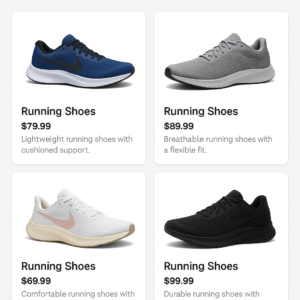
    agentic-commerce-product-card-example

    The card itself is the presentation, not necessarily a special file that every AI system reads in the same way. Different shopping platforms and AI tools may display products differently. The information behind those displays can come from a merchant’s product page, structured data, product feeds, marketplace records or other sources. That’s an important distinction because merchants control much of the information, but they won’t always control exactly how an AI interface displays it.

    For instance, a merchant might provide five excellent photos and a long description. A shopping assistant might choose to surface just one photo, a short summary, the current price and a couple of distinguishing features. If the underlying catalog information is incomplete, the assistant has less reliable material to work with.

    Seven Things a Useful Product Card Should Communicate

    Whether the card appears on a retailer’s website, a marketplace or an AI shopping interface, I’d focus on these essentials:

    • Product identity: A recognizable brand and product name, plus the model, size or variation when relevant. Make it obvious which item is actually for sale.
    • Clear, honest photos: Show the item accurately, from useful angles, and include details that help shoppers understand scale, fit, finish or condition.
    • Price and offer: Display the selling price and applicable promotion clearly. The final cost may also depend on shipping, taxes or other charges.
    • Useful specifications: Dimensions, materials, compatibility, weight, features and product identifiers can help distinguish a true match from a lookalike.
    • Ratings and reviews: Give shoppers context for customer feedback. A rating by itself is less useful if we don’t know how many people contributed or what they liked and disliked.
    • Inventory and delivery: A recommendation isn’t very helpful if the item is out of stock or cannot arrive when the customer needs it.
    • Return and warranty information: Especially for products with fit, performance or compatibility questions, clear policies can remove an important reason to hesitate.

    I would add one more principle that isn’t always visible on the card: the information needs to be consistent wherever the item is listed. A product that shows one price on the website, another in a marketplace feed and an outdated availability status in search creates confusion. In an AI-assisted shopping experience, bad data may be repeated at the very moment a customer is ready to buy.

    How an AI-Assisted Purchase Could Work

    Here’s the shopping journey I envision as these systems improve. Not every AI tool can perform all five steps today, and some purchases will continue to require direct customer approval.

    1. The shopper explains the need. They describe the budget, purpose, preferences and delivery requirements in ordinary language.
    2. The assistant discovers possibilities. It searches available product information and considers which listings meet the stated requirements.
    3. The assistant compares and explains. It presents a smaller group of products, perhaps with cards that highlight price, specifications, reviews and important tradeoffs.
    4. The shopper chooses. The customer reviews the recommendation and decides whether a product deserves a closer look or a purchase.
    5. Checkout and fulfillment follow. The customer may click through to the merchant to complete the order. More autonomous purchasing could develop with permission and suitable payment safeguards.

    What fascinates me is how this changes the work on both sides of the sale. The shopper might spend less time filtering through dozens of pages. The merchant might have fewer opportunities to win attention through clever navigation or a flashy homepage if the AI assistant has already narrowed the field before the shopper arrives.

    Why Product Cards Matter to eCommerce Merchants

    Visibility Starts With Relevant, Reliable Information

    Traditionally, merchants have worked hard to show up when someone searches for a product. That work doesn’t disappear. But an AI assistant may try to understand the shopper’s intent more precisely than a short keyword phrase. If somebody needs an office chair that fits a small apartment, the seat dimensions, adjustability and shipping size could all become relevant.

    My concern is that merchants sometimes treat product information as a chore. They enter the minimum necessary to get a listing live and move on. In a world of AI-assisted comparisons, thin product data may be a competitive disadvantage. Better information doesn’t guarantee a recommendation, but missing or inaccurate details certainly don’t help.

    Trust Still Determines Whether People Buy

    An AI assistant can make a recommendation, but the shopper still has to feel comfortable with the merchant and the item. Reliable pictures, clear terms, credible customer feedback and realistic delivery promises are all part of that confidence. This is especially important when the customer has never heard of the seller before.

    I think merchants should resist the temptation to write product descriptions entirely for machines. The real customer is still a human being. Your listing needs to answer practical questions in language someone can understand, even if an AI system is involved in discovery.

    Comparison Can Make Weaknesses More Obvious

    There is a downside to making comparison easier: shoppers may see more clearly when one offer costs more, delivers more slowly or provides less information than another. A product card can help a strong offer stand out, but it can also expose a weak one. That’s not necessarily a bad thing. It encourages merchants to compete on real value.

    Price isn’t the entire story. A dependable seller, a better warranty, clearer instructions or faster delivery might justify a higher price for the right customer. The goal should be to communicate what makes your offer worth choosing, not merely to stuff a card with keywords.

    SEO, GEO and Structured Product Data: How They Fit Together

    There’s already discussion about Generative Engine Optimization (GEO), or how businesses might become more visible in AI-generated answers. I think it’s worth paying attention to, but I wouldn’t declare traditional search engine optimization dead. Search engines, marketplaces and AI assistants may all use overlapping information, while choosing what to display in different ways.

    One practical place to start is product structured data. Standards such as Schema.org Product and Offer can help make details like a product’s name, price, availability and reviews more explicit to systems that support those formats. Google has long offered merchant listing and product-result features based in part on structured data. That does not mean every AI shopping assistant reads Schema.org in exactly the same way, or that markup guarantees visibility.

    A merchant’s website, product feed and marketplace listings should also agree on the basics. If the item is sold out, show that. If the price changes, update it. If a product comes in different sizes or colors, distinguish the variants correctly. You can review Google’s merchant listing structured data documentation for a practical starting point.

    My opinion? Don’t chase a mysterious AI optimization trick while your product data is a mess. Start with the information you can control and make it accurate, useful and consistent. Those improvements are good eCommerce practices even if the industry’s next preferred acronym changes.

    Five Practical Steps to Get Your Catalog Ready

    If I were reviewing a merchant’s catalog for this shift, I wouldn’t start by buying a complicated new tool. I’d start by checking the actual listings and customer experience.

    1. Audit your best-selling and highest-potential products first. Identify listings with incomplete titles, missing specifications, outdated prices, weak photos or confusing variations.
    2. Make product information specific. Describe what the item does, who it suits and any important limitations. Include model numbers, compatibility and attributes customers routinely ask about.
    3. Review your product feeds and structured data. Make sure eligible merchant listings accurately reflect price, inventory, shipping and other supported details.
    4. Improve the buying experience. Test product pages on mobile, review shipping promises and return policies, and make it easy to find answers before purchase.
    5. Measure what actually improves results. Watch product discovery, engagement, conversion, returns and customer questions. A better-looking card is useful only when it helps the business and the buyer.

    I’d also keep an eye on how AI shopping results are evolving. Try asking an assistant the kinds of questions your customers ask, then see what information it surfaces and what it leaves out. Use that as research into how your products are described—not as proof that one test reveals the rules of a secret ranking algorithm.

    My Take: Better Product Data Is a Business Asset

    I’ve seen eCommerce change plenty of times, and each wave of technology seems to arrive with a promise that everything will be different. Some parts really do change. But buyers still want the right item, a fair deal, dependable fulfillment and the confidence that they’ll get what they ordered. The tools for connecting buyers and sellers are what keep evolving.

    That’s why I’m interested in product cards. They make the next generation of shopping easier to picture. Instead of asking customers to work through endless listings, an assistant may do the first round of research and offer a clear, manageable comparison. Merchants that communicate product information clearly should be better prepared for that experience.

    I don’t think a beautifully formatted product card, by itself, is going to make anybody successful. The product has to be right. The information has to be right. The business behind the offer has to work. But as AI becomes part of the shopping process, getting those fundamentals right could matter more than ever.

    It’s still early in this transition, and we have plenty to learn about how customers will use AI to shop. That’s exactly why I think eCommerce merchants should be watching it now. What would an intelligent shopping assistant discover about your products today? And would you be happy with the answer?

    Further Reading

    ChatGPT’s April 2025 shopping updates — TechCrunch · Google Search Central: Product merchant listings


    Disclosure: AI helped create this article

  • GEO (Generative Engine Optimization): The AI-Driven Evolution Replacing SEO

    GEO (Generative Engine Optimization): The AI-Driven Evolution Replacing SEO

    TL;DR — The Takeaway

    GEO—Generative Engine Optimization—is about becoming visible and useful when AI answers questions instead of simply listing websites. This could change how shoppers discover businesses and products. My advice: don’t abandon SEO. Build on it with useful content, trustworthy reputation, accurate product information, and a better customer experience.

    For years, anybody selling products online has heard the same advice: get found in search. Search Engine Optimization—SEO—became part of the language of eCommerce. We learned to think about keywords, product titles, useful content, links, and how to get a prospective customer to click through to our store.

    Now something interesting is happening. Instead of searching and sorting through a long list of websites, shoppers can ask an AI assistant a fairly detailed question and receive an answer that brings information together from multiple sources. They might ask for an explanation, a comparison, or a product recommendation. What happens to SEO when the search engine starts answering the question itself?

    That’s why I’m paying attention to GEO, or Generative Engine Optimization. I think this change has the potential to reshape product discovery. But I wouldn’t turn off an existing SEO strategy tomorrow. We are seeing a new layer develop around search, and there is still a lot we don’t know.

    What Is Generative Engine Optimization?

    GEO is an emerging way of thinking about whether a business, website, or product is discoverable and useful in AI-generated answers. Traditional search engines have generally presented ranked links to pages. AI-powered systems may instead synthesize an answer, sometimes referencing the websites, brands, and sources they used.

    There is already research on this idea. The paper GEO: Generative Engine Optimization, first shared as a preprint in 2023 and presented at KDD in 2024, explores how creators can improve visibility in generative responses. It’s an interesting starting point, not a guarantee that any particular optimization will earn a recommendation from every AI service.

    For a merchant, imagine somebody asking: “What are the best walking shoes under $120 for someone who spends all day on their feet?” A traditional search might display shoe stores, reviews, articles and ads. An AI assistant could interpret the question, compare several choices, and explain which products might fit the need.

    This changes where an initial buying decision could happen. The customer still needs a good product and a trustworthy merchant, but they may not visit ten websites before narrowing the choices. Being understandable and credible in the information AI systems can find could matter as much as ranking for a short keyword phrase.

    Here’s the illustration from my original GEO article:

    GEO replacing SEO for ecommerce

    GEO Versus SEO: What’s the Difference?

    SEO focuses on helping search engines discover, interpret and rank website content. It includes useful pages, relevant language, links, clear site organization, technical accessibility and sound product information. Those fundamentals still matter.

    GEO asks a different question: When an AI system puts together an answer, what information does it use, and will our products or business be part of that answer? Instead of only measuring a position on a results page, we may need to think about whether information is understood, mentioned, cited or recommended.

    There is another important distinction: GEO is not exactly the same as agentic commerce. GEO concerns visibility in AI-generated discovery and answers. Agentic commerce involves an AI assistant helping a customer research, compare, or potentially buy a product with the customer’s permission. They can work together, but one is not a substitute for the other.

    We’ve already seen some movement. In March 2025, Google announced improvements to AI Overviews and an experimental AI Mode. In late April, ChatGPT introduced enhanced shopping results that can include product pictures, prices, reviews and direct merchant links. These are signs of changing discovery behavior, not evidence that regular search is gone.

    Why AI Discovery Could Change the Shopping Experience

    1. A Shopper Can Explain the Problem Instead of Guessing Keywords

    Someone shopping for an office chair might describe their budget, body size, workday and whether the chair needs to fit into a small apartment. An AI assistant can try to interpret the full request rather than matching only a few words. That’s useful to the buyer, but it demands more from the seller’s product information.

    An incomplete description that says “premium office chair” doesn’t tell the system much. Seat dimensions, weight rating, adjustability, return terms and shipping information are more helpful. Good information allows both people and software to make better comparisons.

    2. Product Comparisons May Happen Before the Merchant Gets a Click

    I think this could be one of the biggest changes for eCommerce merchants. We’ve spent years trying to get customers into our stores so we can explain why our products are worth buying. What if an AI assistant does the first round of comparisons before anybody visits the store?

    It doesn’t mean the merchant loses the chance to sell. It means the information used at that earlier stage may have a bigger impact. Inaccurate features, stale prices or unclear variations could create problems before the customer ever reaches the product page.

    3. AI Recommendations Still Have Limitations

    We also need to keep our expectations realistic. AI tools can misunderstand a request or display information that is out of date. Different assistants may rank or describe products differently. And in many of today’s shopping experiences, the customer still visits a retailer to complete the purchase.

    A merchant can’t force an AI assistant to recommend a product by adding a few keywords or installing a plugin. Our job is to improve the information and experience we control, not pretend there’s a guaranteed formula for AI rankings.

    Three GEO Priorities for eCommerce Merchants

    1. Clean, Structured and Up-to-Date Product Information

    I’d start with product names, model numbers, dimensions, materials, compatibility, sizes, colors, prices, availability, shipping promises and other practical details. If an item has several variations, identify them clearly. If a price changes, update it everywhere it appears.

    Structured data, such as Schema.org Product and Offer markup, can make supported product attributes easier for search systems to interpret. Google also provides merchant listing structured-data guidance. But structured markup doesn’t automatically qualify a product for every AI shopping tool, and it can’t make up for inaccurate inventory or poor descriptions.

    My take: Fix your catalog before buying expensive software to push the same bad catalog into more places! Clean data helps the website, the marketplace listing, the customer and potentially the AI assistant. It is a useful investment regardless of which interface wins.

    2. Reputation and Customer Trust

    The original article emphasized reputation, and I think that’s essential. Reviews, seller reliability, clear business information, shipping policies and honest descriptions all help a shopper decide whether to trust a merchant. If customers routinely complain that the product isn’t what was advertised, no amount of clever optimization makes that a good business.

    I wouldn’t fabricate reviews or try to game an AI tool’s trust signals. Instead, encourage authentic customer feedback, correct mistakes and communicate clearly. Trust is built through transactions, not simply through page formatting.

    3. Personalization That Helps Real People

    AI could allow shoppers to ask for a much more personalized recommendation. A buyer looking for hiking shoes might specify terrain, weather, fit, budget and a delivery deadline. Better product attributes can help match a specific need to a specific offer.

    But that doesn’t mean every seller needs an elaborate prediction engine collecting huge amounts of customer information. Sometimes personalization begins with explaining which product is best for beginners, which works for heavy use and which one costs less. Help the customer make an informed decision, whether an AI assistant is involved or not.

    Six Practical Steps I’d Recommend

    If I were reviewing a merchant’s GEO readiness today, I wouldn’t begin with an expensive new platform. I’d look at the actual product information and the questions buyers ask.

    1. Audit important product listings. Check your best-selling and high-potential products for missing details, weak images, ambiguous names and incorrect prices.
    2. Answer real customer questions. Explain intended use, fit, compatibility, limitations, delivery times, warranties and returns.
    3. Make product data consistent. Compare the website with product feeds and marketplace listings, including variation and stock information.
    4. Use supported structured data. Apply product markup where appropriate, validate it, and continue the normal technical SEO work.
    5. Strengthen genuine credibility. Make policies clear, offer good service and encourage honest customer feedback.
    6. Experiment and measure. Ask AI shopping tools the kinds of questions customers might ask, then monitor whether improving the underlying content also helps discovery and sales.

    I would still spend time on titles, useful page copy, internal links, fast pages and other established SEO practices. We don’t have to choose between basic SEO and GEO. The best improvements often help both.

    Is GEO Really Replacing SEO?

    My headline is intentionally bold because I believe we’re looking at a meaningful change in how customers will discover products. For decades we’ve helped shoppers find links. Now AI services may begin helping them get answers, compare choices and move toward purchasing.

    But I don’t think we can declare SEO dead in May 2025. AI systems still need sources of information, and ordinary search remains a major way customers find businesses. GEO is better understood as a new discovery challenge building on the foundations of SEO, not a reason to abandon them.

    The opportunity is to become the kind of merchant whose products are easy to understand and whose information can be trusted. If the product is wrong, the price is inaccurate or fulfillment is unreliable, being mentioned by an AI won’t fix the underlying business.

    The Opportunity I’m Watching

    What interests me most is the possibility that a shopper will describe a problem in plain English and receive a useful shortlist of products rather than a thousand links to sort through. That could make shopping easier, and it could create opportunities for merchants whose products meet specific needs but don’t have the biggest advertising budgets.

    It could also create new challenges. If an AI narrows the shopping decision before a consumer visits your store, product attributes, accuracy and reputation may become more important than ever. We should be watching closely and learning from what the tools actually do.

    My advice: stay curious, keep experimenting and don’t neglect the fundamentals. The tools are changing, but customers still want the right product, a fair price, dependable delivery and a seller they trust. Would an AI assistant find enough accurate information about your products to recommend them confidently? That’s the question I’d start asking.

    References and Further Reading


    Disclosure, AI helped create this post

  • ChatGPT will Buy Your Items for You – eCommerce Shopping Agentic Commerce

    ChatGPT will Buy Your Items for You – eCommerce Shopping Agentic Commerce

    TL;DR — The Takeaway

    AI assistants are beginning to change how people shop. In May 2025, ChatGPT can help discover and compare products, but its new shopping results still direct buyers to merchants to complete purchases. I believe more capable agents will eventually handle more of that work. For merchants, the preparation starts with accurate product information, trusted offers, and profitable fulfillment.

    What if you could tell ChatGPT what you wanted to buy, give it a budget, and let it handle most of the shopping? No bouncing between a dozen websites. No trying to remember which store had the best shipping offer. Just a conversation about what you actually need.

    That’s the direction I find exciting about agentic commerce. I’ve watched eCommerce grow from relatively simple listings and search boxes into sophisticated marketplaces that know a remarkable amount about what shoppers want. AI could be another major step in that evolution—because the customer may eventually delegate more of the work instead of doing every comparison personally.

    My headline says ChatGPT will buy your items for you, and I chose that future tense deliberately. As of May 9, 2025, ChatGPT has newly expanded shopping search results, but it does not routinely complete checkout inside ChatGPT. Customers are still sent to a merchant’s website to finish purchasing. The big opportunity is where this process might go next.

    ChatGPT ecommerce agentic commerce shopping

    What Agentic Commerce Actually Means

    Agentic commerce describes shopping tasks performed with help from AI agents that can interpret a goal, take steps toward it, and potentially act on a customer’s behalf. It goes beyond simply displaying search results. A shopper can explain the outcome they want, and the system can do some of the research, comparison, and decision support.

    Imagine asking, “Find me a reliable laptop for travel, under $1,000, with good battery life. I need it delivered before Friday.” A traditional search engine might hand back pages of laptops and reviews. An AI assistant could help narrow that group using the stated requirements, point out compromises, and show a manageable set of options.

    It’s useful to separate shopping assistance from autonomous purchasing. Finding an item, comparing offers, and preparing a recommendation are different from receiving permission to spend money. Payment authority, privacy, returns, seller reliability, and confirming the exact item all become more important as AI systems move closer to checkout.

    What ChatGPT Shopping Can Do in May 2025

    On April 28, OpenAI introduced shopping enhancements to ChatGPT Search. Customers asking about categories such as fashion, beauty, home goods, and electronics can receive visual recommendations with product photos, review information, prices, and links to retailers. The rollout provides a much richer experience than a plain conversational answer.

    What it doesn’t mean is that ChatGPT is already negotiating every deal or independently placing purchases. Reporting at launch makes clear that the actual transaction still happens on the merchant’s website. That’s a crucial distinction. We should be excited about what’s emerging without pretending the entire future has already arrived.

    I think the real change is how the question is asked. A customer can explain a complicated need in ordinary language instead of figuring out which keywords will produce the right result. That gives the assistant more context to work with, and it puts a premium on useful information about products.

    A Shopping Journey That Could Become Very Different

    Here’s how I see this developing. The customer starts by describing the problem or desired outcome, not necessarily a specific item. The AI assistant uses available information to evaluate options, then presents a smaller group with reasons for each recommendation. The shopper can ask follow-up questions or change the budget without starting again.

    • Discover: Identify products that genuinely match a shopper’s needs, budget, and constraints.
    • Compare: Look at specifications, reviews, delivery promises, and total cost instead of just a promotional headline.
    • Recommend: Explain the tradeoffs—why one product is a better value and another may be worth paying more for.
    • Confirm: Let the customer inspect the exact variant, seller, availability, price, and return terms.
    • Purchase: Eventually, with proper permission and safeguards, an agent might help complete checkout and handle follow-up tasks.

    I can imagine the convenience of an assistant also watching an order, asking for an exchange if the size is wrong, or handling a routine reorder. But those are potential future workflows, not features I’m claiming are all available today. The more responsibility we hand to an assistant, the more the customer must remain in control.

    Could AI Negotiate Better Prices?

    One idea I explored in the original article is agents negotiating with retailers or identifying the best deals automatically. It’s certainly interesting to imagine a buying agent and a selling agent discussing a bulk discount or an acceptable substitute. But as of May 2025, that isn’t a universal ChatGPT shopping capability.

    The practical part is closer to home: an assistant may help compare advertised prices and understand the total delivered cost. That can already change how merchants compete. A $49 product with a $15 shipping fee may not look so attractive next to a $54 product with reliable delivery included.

    My take: I’ve always believed the economics matter at the transaction level. A clever AI shopping experience won’t rescue a seller who doesn’t understand product margin, shipping, fees, and returns. AI may make comparisons more transparent, and that makes knowing your numbers even more important.

    What Happens to Online Advertising and Product Discovery?

    Here’s where merchants should be paying attention. We’ve spent years buying search ads, optimizing product pages, and working to get shoppers onto our websites. What if the first meaningful product comparison now takes place inside an AI conversation rather than on our own storefront?

    I wouldn’t declare search advertising or SEO dead. Those channels still matter. But a conversational shopping assistant may rely on product specifications and customer needs that don’t fit neatly into a few traditional keywords. A retailer needs to make it easy for systems and shoppers to understand what a product actually does.

    That means accurate product names, variations, dimensions, features, images, prices, availability, reviews, and shipping information. Structured product data and reliable product feeds can help compatible search and shopping systems interpret those details. None of that guarantees inclusion in an AI response, but it improves the underlying information a recommendation might use.

    Three Things I’d Ask Every eCommerce Merchant to Review

    • Is our product information complete? If a customer needs an ergonomic chair for a small office, can our product listings actually explain dimensions, support, materials, and delivery options?
    • Does the offer inspire confidence? Clear policies, honest photographs, useful customer feedback, and accurate inventory matter regardless of who recommends the item.
    • Can we profitably deliver the promise? If an assistant highlights our product as the best choice, can we ship it on time and handle the transaction, service, and potential return without losing money?

    I would also test how existing AI shopping tools respond to real questions your customers ask. Don’t treat one answer as proof of some secret ranking formula. Use it to learn which parts of your catalog are understandable and which leave important questions unanswered.

    The Merchant Still Has to Win the Customer

    One thing I don’t want to lose in the excitement over autonomous shopping is the human side of the transaction. Somebody still has to trust that the product is what it claims to be. Somebody still has to receive it, use it, and decide whether the experience was good enough to buy again.

    AI might become the front door to a purchase, but the merchant remains responsible for the promise behind that purchase. A good description, a fair price, reliable fulfillment, and responsive service are just as relevant if the buyer arrives through an AI recommendation instead of a search engine.

    To me, that is the exciting part of this shift. The interface can change dramatically while the fundamentals of running a good eCommerce business remain recognizable. The opportunity is to make those fundamentals easier for customers—and their assistants—to see.

    My Take: Prepare for the Direction, Not Just Today’s Features

    I think we’re looking at the beginning of something important. As AI becomes more capable, shopping could become less about finding products and more about describing the result we want. That may help buyers discover good merchants they would never have found through an ordinary keyword search.

    But I’m not ready to tell sellers that ChatGPT will magically handle every order next week. There are legitimate questions about accuracy, authorization, payments, privacy, and the ability to resolve a problem after checkout. Those are business challenges, not just technical problems.

    My advice is to start with what you control. Build better product data, understand your customers, and make sure each order is economically sound. If an AI assistant eventually decides which products to recommend—and perhaps which orders to place—would your business be ready to earn that sale?

    Sources and Further Reading

    WIRED — OpenAI adds shopping to ChatGPT, April 28, 2025 · Search Engine Land — ChatGPT Search shopping features, April 28, 2025


    Disclosure, AI helped write this article

  • Sell the “Best” – eCommerce SEO for Agentic Commerce

    Sell the “Best” – eCommerce SEO for Agentic Commerce

    TL;DR — The Takeaway

    “Best” is a powerful shopping word because it signals a decision. There are two layers to winning the word “best.” First, shoppers constantly ask Google, voice assistants and AI to “find the best.” If your product doesn’t appear in credible search results, reviews and comparisons, the AI may never discover why it belongs on the shortlist. Second, “best” becomes personal: the ideal product depends on the buyer’s needs. Earn the visibility, then prove the fit.

    Think about how often shoppers search for the word best. Best laptop. Best running shoes. Best coffee maker. Best place to stay. It’s a small word, but it’s an important signal: somebody is moving beyond browsing and trying to make a decision.

    Think about the way people actually search. Sitting at a computer, looking at a phone or talking to a voice assistant, how often does the request sound like this: “Find me the best pair of shoes.” “What’s the best office chair?” “Show me the best coffee maker.” They don’t necessarily know a brand or model number. They start with that one little word: best.

    That’s my first point, and I think it’s a big one. If your product isn’t discoverable in the places a shopper—or the AI doing research for that shopper—looks for evidence of what’s best, how will it make the list? Once an assistant identifies possible choices, a second question becomes important: best for whom? Both layers matter.

    Here’s the opportunity I see for eCommerce sellers and publishers: become one of the products customers and AI tools can actually find when they ask for the best, and then provide a convincing reason that your offer is best for the right buyer. Calling yourself the best isn’t enough. You need visibility and evidence to back it up.

    best seo for agentic commerce

    Why “Best” Has Always Been a Valuable Search Term

    In traditional SEO, “best” often signals commercial investigation. A shopper using that word may be comparing products before purchasing rather than just looking for a definition. That’s why review sites and comparison articles have attracted attention around queries like “best affordable cameras” and “best office chairs.”

    But this word has also created a crowded content category. Search for almost anything and you’ll find a site promising its “Top 10 Best” choices, sometimes with little explanation of who did the testing or what qualifications the author has. Just because a page ranks well—or contains the keyword—doesn’t automatically mean its recommendation deserves trust.

    As someone who’s spent years thinking about how products get sold online, I find the purchase intent interesting. But I’d caution sellers against mistaking a popular word for a complete strategy. The word attracts a question. The content has to answer it.

    Layer One: When People Search for the “Best,” Will AI Find You?

    My original theory is simple: people use the word “best” as a shortcut when they’re ready for help choosing. It’s a natural request, especially when someone is using voice search or asking an AI assistant a question. They may not want a hundred alternatives; they want someone to narrow the field.

    For years, search engine optimization has helped businesses and publishers appear when somebody asks for the best product in a category. Strong product pages, helpful comparison content, independent reviews, relevant links and credible mentions all contribute to a brand’s visibility. If you sell office chairs but nobody reviewing chairs mentions yours, and your own pages provide little evidence of quality, an assistant doing product research may have fewer reasons—or fewer opportunities—to consider you.

    This is the first layer of the challenge: you have to be part of the information ecosystem that answers “what’s best?” The goal isn’t to place the word “best” in every product title. It’s to make the product genuinely discoverable through useful SEO content, honest customer reviews, accurate product data and independent comparisons where relevant.

    I would pay particular attention to what people see when they search for your product category. Are credible publications comparing the products? Are customers reviewing them? Is your own website answering the questions buyers ask? Do your claims match the product’s actual performance? If an AI agent can’t find dependable signals about your product, it may overlook a perfectly good offer. That’s a commercial risk worth thinking about—even though no one can promise how a given AI assistant will choose its sources.

    Layer Two: What Does “Best” Mean for This Particular Buyer?

    If you ask an assistant for the best office chair, the first useful answer might actually be another question: “Best for what?” Long hours at a desk? Back support? A small space? A $250 budget? The same chair won’t be the right fit for every person.

    That’s a meaningful shift from chasing a generic number-one ranking. A shopper can add details in natural language, and the assistant can compare products against those criteria. A merchant who provides accurate dimensions, material, adjustability, warranty, delivery, and return information gives a system more to work with.

    In late April 2025, ChatGPT began rolling out enhanced shopping results with product images, prices, review information, and links to merchants. It’s still early, and those features don’t establish a universal formula for how assistants select recommendations. But they show why clear, comparable product information could become increasingly valuable.

    My take: First we have to get our products into the conversation. Then we have to give the AI enough information to understand the individual buyer. Best value? Best fit? Best durability? Best for a beginner? Visibility gets you considered; relevance gives you a chance to be chosen. I would rather show why an item is the right match than pretend it’s the best for everybody.

    The Opportunity—and the Problem—with “Best Of” Lists

    Comparison publishers such as Wirecutter and CNET have built audiences by helping people select products, while affiliate-driven sites can earn commissions when readers buy through their links. Some of these guides involve extensive research or hands-on testing. Others don’t. That difference matters.

    An AI assistant evaluating a purchasing question might find comparison articles useful because they summarize specifications and tradeoffs. But we shouldn’t assume every assistant favors pages with “best” in the title or automatically treats all affiliate guides as authoritative. The actual selection methods differ by platform and aren’t fully public.

    And there is a credibility issue. If a page is designed mainly to collect affiliate commissions, the recommendation may be influenced by the economics of the publisher rather than the needs of the shopper. That doesn’t mean all affiliate content is bad. It means the research, testing, disclosures, and reasoning ought to be clear.

    Personally, I’d be more impressed by an article that says “Here are the three products I’d consider, and here’s who each one is for” than by a list of ten products with identical five-star descriptions. A useful comparison explains tradeoffs, not just winners.

    How Merchants Can Earn a Place in Better Recommendations

    The original article explored how retailers might optimize for “best” searches, and I still believe that’s a valuable opportunity. I’d approach it from both sides: be visible and credible when a shopper asks for the best, then make sure your information demonstrates who the product is best for. That is more useful than trying to reverse engineer a secret AI ranking formula.

    • Describe the actual customer. Explain the scenarios a product serves well and where it may be a poor fit. “Best for a small apartment” is far more specific than “best chair.”
    • Publish accurate product details. Dimensions, compatibility, materials, size charts, price, stock, and shipping information help both people and software compare options.
    • Make evidence visible. If you publish a comparison, explain your criteria, how you evaluated the products, and any limitations in your research.
    • Show credible feedback. Real reviews and useful customer questions may reveal strengths and weaknesses more clearly than marketing copy.
    • Earn credible third-party attention. Encourage genuine customer feedback and make it easy for legitimate reviewers and comparison publishers to understand your product. Disclose paid placements, affiliate commissions, free samples, and other material connections where appropriate.
    • Maintain the basics. Clear page structure, useful headings, internal links, mobile performance, and supported structured data remain valuable for search and shopping.

    Structured markup can help compatible search systems interpret a product or review, but adding it doesn’t guarantee a recommendation. Likewise, getting an article linked from a respected site can help readers discover it and support traditional SEO, but it would be misleading to promise that an AI agent treats every backlink as a direct vote.

    What I’d Change About a Typical “Best Products” Article

    Suppose you sell outdoor equipment and want to publish a guide called “Best Camping Stove.” I’d start by defining the categories: best for backpacking, best for family camping, best budget choice, and perhaps best for cold weather. Then I’d explain the criteria behind those selections.

    Weight, fuel availability, cooking speed, safety, price, and durability might matter. I’d also include honest limitations. A tiny lightweight stove might be perfect for one person hiking, but a poor recommendation for a family cooking dinner at a campsite.

    That approach creates something valuable for readers today and potentially useful information for conversational search tomorrow. A shopper who asks an AI assistant for a small stove to cook for four people is describing a specific problem. The more clearly a merchant or publisher answers that problem, the better.

    One more thing: if you haven’t actually tested a product, don’t imply that you have. Credibility is an asset worth protecting, especially when shoppers are already questioning how much online content is written to rank instead of written to help.

    SEO, AI Shopping, and the Difference Between Visibility and Sales

    There’s a temptation to make every new development sound like the end of the previous one. I don’t think that’s the most useful way to run a business. Traditional SEO is still important in May 2025. AI-driven discovery may add another way people find and compare products.

    Even if a merchant appears in an AI recommendation, there is more work to do. The item needs to be in stock, accurately described, fairly priced, and shipped as promised. The customer has to trust the seller. A recommendation that produces a disappointing transaction doesn’t make for a healthy business.

    So I would measure more than rankings or mentions. Are the right shoppers discovering the products? Are they converting? Are they returning items because expectations weren’t clear? Is there enough margin left after advertising, fees, shipping, and customer support?

    I’ve always found that the numbers behind a sale matter. Winning attention is useful. Winning a profitable, satisfied customer is better.

    My Take: Sell the Best Answer, Not Just the Word “Best”

    The word “best” isn’t going away. People will keep asking phones, search engines and AI assistants to find the best products because it’s a natural way to shop. My original point is that merchants need to be visible in the search results, reviews and trusted comparisons that help answer that question. If your product is invisible to the sources a shopping assistant consults, it may never enter the conversation.

    The second layer is where AI could become genuinely useful. Instead of asking what’s best in general, the shopper can say what’s best for me—my budget, my preferences, my delivery deadline. Merchants can prepare by being exceptionally clear about the people an item serves and the tradeoffs involved. Publishers can help by making their comparisons fair, specific and useful.

    That’s the two-layer opportunity: become discoverable when people ask for the best, and give an AI assistant the evidence to determine when you’re the best fit. If somebody asks for the best product in your category today, does your business even show up in the places that answer the question? And if it does, is there enough useful information to justify recommending it?

    Further Reading

    Search Engine Land — ChatGPT shopping search launches, April 28, 2025 · FTC — Endorsements, reviews, and influencer guidance


    Disclosure: AI helped generate this blog post.

  • Agentic Commerce: Revolutionizing Online Shopping with AI

    Agentic Commerce: Revolutionizing Online Shopping with AI

    TL;DR — The Takeaway

    Agentic commerce could change online shopping from searching and clicking to asking and delegating. AI can help shoppers describe a need, compare products and narrow their choices. In May 2025, fully autonomous purchasing is still largely a direction rather than the standard experience. For merchants, the opportunity begins with accurate product information, honest value, reliable fulfillment and a trustworthy business worth recommending.

    I’ve been involved in eCommerce long enough to remember when online shopping was largely about finding a listing, studying a few photographs and deciding whether to trust the seller. Today we have enormous marketplaces, sophisticated recommendations and more choices than most shoppers can reasonably evaluate.

    Now another change is taking shape. What happens when the customer doesn’t have to do all the searching? What if they can explain what they need to an AI assistant and let that assistant do much of the research? And what happens when the assistant eventually becomes capable of taking certain actions on the shopper’s behalf?

    That’s the opportunity I see in agentic commerce. The technology is exciting, but I want to look at it from both sides of the transaction: what it means for the customer and what it might mean for the people selling, shipping and standing behind the merchandise.

    agentic commerce for online sellers

    What Is Agentic Commerce?

    Agentic commerce describes using AI agents to help accomplish shopping tasks on behalf of a customer. A shopper expresses a goal, the agent works through steps toward that goal, and—with the appropriate permission—could eventually help take actions. That’s more capable than a traditional recommendation engine that simply suggests an item because other shoppers bought it.

    For example, somebody might ask an assistant to find a carry-on suitcase under $180 that meets a particular airline’s size rules, has durable wheels and can arrive before a trip. Instead of showing hundreds of suitcases, the AI could compare measurements, reviews, prices and shipping promises and help narrow the choices.

    There’s an important distinction between assisting a purchase and making a purchase. Finding useful options isn’t the same as receiving permission to spend money or manage an account. Accurate checkout, privacy, payment authorization and returns become significant issues as more of that responsibility moves to software.

    We can already see an early example. On April 28, 2025, ChatGPT began rolling out visual shopping results with photographs, prices, review information and links to merchants. Customers still go to retailers’ websites to complete their purchases. That is a meaningful step in discovery—not proof that fully autonomous shopping has already become commonplace.

    Four Ways AI Could Transform the Shopping Experience

    1. Personalization That Starts With the Customer’s Actual Problem

    Traditional search can be limited by the words people think to type. A customer might search for “best office chair,” even though they really need a chair for a small desk, a long workday, a specific budget and delivery next week. An AI conversation can include all those requirements, and perhaps ask follow-up questions.

    I find that especially interesting because customers aren’t always shopping for a product; they’re trying to solve a problem. If an assistant can understand the problem better, a merchant with an appropriate product may have a better chance of being considered.

    2. Better Comparisons With Less Browsing

    Think about buying a laptop. You could spend hours sorting through specifications and reviews, with a dozen browser tabs open. An assistant could help identify a smaller group, explain tradeoffs and clarify which models meet the requirements.

    But an AI comparison is only as reliable as the information behind it. Prices change, a particular configuration may be unavailable, and reviews don’t always tell the whole story. A fast answer isn’t necessarily an accurate answer. The final details still deserve a look before purchasing.

    3. Better Pricing Research—and Perhaps Future Negotiations

    The original article explored the possibility of AI agents negotiating with retailers or finding personalized offers. That’s a fascinating direction. Imagine a buying assistant identifying bulk discounts, comparing bundled offers or interacting with a seller’s pricing system.

    As of May 2025, I wouldn’t describe autonomous agent-to-agent negotiation as a routine shopping feature. For most customers, the more practical opportunity is comparing publicly available prices and factoring in delivery costs. A $49 product with expensive shipping might not be a better deal than a $55 product delivered reliably.

    My take: The best deal isn’t always the lowest sticker price. Product quality, warranty, seller credibility, shipping and returns can change the equation. And on the seller’s side, even the cleverest pricing algorithm can’t rescue a transaction that loses money.

    4. Automation of Routine and Post-Purchase Tasks

    I can envision an assistant helping with repeat orders, subscriptions, shipment tracking or the first steps in a return. These are the routine jobs that can consume time without adding much value for the person doing them.

    But customers must be able to set limits and correct mistakes. An AI ordering the wrong size every month wouldn’t be much of an improvement! Delegating a task shouldn’t require giving away control.

    Four Priorities for Online Sellers

    1. Product Data and Transparency

    If an AI is comparing products, it needs usable information. Product names, model numbers, dimensions, colors, materials, variations, compatibility, prices, availability and shipping information all become important. Clear photographs and genuine customer reviews can help answer questions a short description might miss.

    A replacement auto part is a good example. The customer needs to know which models it fits and what happens if it doesn’t work. A listing that says “premium quality” isn’t much use when the buyer needs precise compatibility. The same problem exists with furniture, apparel and electronics.

    Structured data and product feeds can help compatible systems read some of those attributes. But there’s no universal magic AI tag that guarantees a recommendation. Clean, useful catalog information is where I’d begin.

    2. Pricing That Makes Financial Sense

    The original discussion anticipated more dynamic pricing, and I think sellers should understand the possibility. AI comparison tools may make it easier to spot when one merchant offers a higher price, slower delivery or less value than another.

    Still, I wouldn’t assume every merchant needs an AI-driven pricing engine right now. Before automating the selling price, understand the underlying costs: inventory, fees, packaging, shipping, customer support and returns.

    My take: Know your transaction-level profit before letting software change the price. It’s entirely possible to win more orders while earning less money if an automated tool keeps chasing the lowest price.

    3. Reliable Systems and Fulfillment

    An AI assistant may confidently recommend an item based on a price and delivery date that aren’t accurate anymore. Merchants with disconnected inventory and fulfillment systems can create a bad customer experience before the order is even placed.

    Over time, AI agents may interact with merchant systems through product feeds, APIs or other secure integrations. That will be important. But I wouldn’t tell a small business to build a complicated new interface before fixing the systems it already uses.

    Keep stock synchronized, checkout dependable, delivery commitments realistic and customer service able to resolve a problem. The operation behind the website still has to deliver what the technology promises.

    4. Marketing When the AI Helps Choose the Shortlist

    We’ve spent years trying to attract visitors through search engines, marketplaces, advertising and social channels. What happens if an AI assistant helps a buyer decide which three products to consider before the shopper ever visits a store?

    That could change where product visibility matters. I wouldn’t declare traditional SEO or advertising obsolete, but I would focus on what helps shoppers and their assistants recognize a relevant offer: useful pages, precise attributes, authentic reviews, good descriptions and a credible business.

    My take: The goal may become less about a clever keyword and more about earning a place in the customer’s consideration set. Merchants should be curious without pretending that anyone has a guaranteed formula for how every AI agent ranks products.

    Trust and Control Matter More as Automation Grows

    It’s easy to imagine the convenience of saying, “Find this for me and buy it.” It’s also worth thinking about what happens if the assistant selects the wrong size, misunderstands a requirement, chooses an unreliable seller or spends more than the customer intended.

    Payment authorization, privacy, clear return terms and transparent recommendations aren’t minor details. They are essential to the customer’s willingness to trust an automated buying process. How does an assistant distinguish a trustworthy recommendation from an ad? Who resolves a dispute? Can the customer verify the total delivered cost before authorizing a purchase?

    Those questions don’t disappear when the technology gets smarter. In fact, the more an agent does, the more important the boundaries become. Trust isn’t a decorative feature. It’s part of the commerce infrastructure.

    Five Things I’d Do to Prepare an eCommerce Business

    • Audit the product catalog. Check the most important listings for accurate names, specifications, variants, prices, stock, photographs and delivery terms.
    • Answer actual customer questions. Explain who the product is for, what it does, how it compares with alternatives and which limitations buyers should know.
    • Build credible reviews and clear policies. Encourage authentic feedback and make returns, warranties and support easy to understand.
    • Measure the whole transaction. Know the costs of merchandise, platform fees, fulfillment, shipping, service and possible returns before chasing the lowest price.
    • Experiment with the tools available today. Ask AI shopping assistants the questions real buyers might ask and see what information appears. Treat the results as research, not proof of a secret ranking algorithm.

    I would also keep watching announcements such as ChatGPT’s April shopping update and how customers respond. Some new interfaces will succeed and others may disappear. Improvements to catalog quality, operations and customer trust will remain useful either way.

    My Take: The Shopping Interface Changes, but the Seller Still Has to Deliver

    From early marketplace listings to today’s personalized shopping experiences, the tools of eCommerce keep changing. Agentic commerce could make the journey from a customer’s question to a completed order far more convenient. That’s a meaningful opportunity for both shoppers and sellers.

    But somebody still needs to source a good product, represent it honestly, deliver it as promised and stand behind the sale. AI might eventually do much of the research or help execute an authorized purchase. It won’t turn a bad product or a broken business model into a good one.

    I’m enthusiastic about the direction, but I don’t think the answer is to throw away everything we know about selling online. Build better data, understand your customer, protect profitability and make the buying experience dependable. Those steps position a merchant to benefit from new shopping technology without betting the business on a prediction.

    Here’s the question I would put to any online seller: If a customer asked an AI assistant to find the right product in your category, would your business give that assistant a good reason to choose you?

    Sources and Further Reading

    WIRED — OpenAI adds shopping to ChatGPT, April 28, 2025 · Search Engine Land — ChatGPT shopping features, April 28, 2025


    Disclosure: AI helped generate this blog post.

  • What Is Agentic Commerce? eCommerce Buying Online – Automated

    What Is Agentic Commerce? eCommerce Buying Online – Automated

    TL;DR — The Takeaway

    Agentic commerce is the idea of letting an AI assistant handle more of the shopping process for you. It could learn your preferences, compare products, prepare purchases and help with delivery or returns. But as of May 2025, the most ambitious fully autonomous buying scenarios are still developing. The real opportunity is convenience with clear customer permission, accurate information and control over the final decision.

    How much time do we spend shopping for things we already know we need? Dog food, coffee, household supplies, birthday presents, replacement parts. We search, compare prices, check the delivery date, read reviews, and eventually make a decision. Then we repeat much of the process the next time.

    That’s why agentic commerce has my attention. What if, instead of doing every step ourselves, we could tell an intelligent assistant what we need and let it take care of the research? What if we could eventually give it permission to handle certain routine purchases, while still setting the budget and the rules?

    I’ve watched eCommerce evolve through a lot of changes, but this one is interesting because it could shift some of the work from the shopper to software. Let’s look at how that might work, what exists today, and what I’d want to be careful about before handing an AI the company credit card—or even my own!

    agentic commerce shopping

    What Is Agentic Commerce, Exactly?

    Agentic commerce means using an AI agent to work toward a shopping goal on a person’s behalf. Instead of just showing a list of search results, the assistant can understand a request, investigate options, explain tradeoffs and potentially take additional actions if it has the right tools and permission.

    Here’s a simple example. You regularly buy a particular dog food, and your dog has a specific dietary requirement. Rather than remembering to reorder it every month, you might ask an assistant to watch your supply, compare available offers, and remind you when it’s time. A more capable future agent could place an order after checking the product, price and delivery window against rules you’ve approved.

    There is an important distinction between recommending and purchasing. In late April 2025, ChatGPT started rolling out richer shopping results, including product images, prices, reviews and links to retailers. Those links take shoppers to merchants to buy. That’s a real example of AI-assisted discovery, not a claim that ChatGPT routinely completes all purchases itself today.

    The bigger vision goes beyond finding an item. I think about it as a four-step journey: learning what matters to you, researching the market, taking an authorized action, and managing what happens afterward.

    Step 1: Teaching the AI Agent About You

    Before an assistant can be helpful, it needs to understand what you actually want. That doesn’t necessarily mean handing it unlimited access to your financial records or buying history. It can start with a few preferences you choose to provide.

    • Product preferences: Brands you like, items you regularly buy, sizes, compatibility requirements and features you care about.
    • Budget and value: Spending limits, whether you prioritize the lowest price or the best overall value, and whether faster delivery is worth extra money.
    • Timing: How often you need a refill or when something must arrive, such as a gift before a birthday.
    • Restrictions: Dietary needs for pet food, product allergies, merchant preferences or a rule that certain purchases always require approval.

    The original idea included AI learning from purchase histories, conversations and calendars. That’s one possible direction if the customer explicitly connects those sources, but we shouldn’t assume every agent automatically has that information. Permission and privacy ought to be part of the design, not an afterthought.

    My take: The advantage of a personal shopping agent isn’t that it remembers everything about you. It’s that it remembers the right things and lets you change your mind. Somebody who bought a certain brand last year may want to switch today. An intelligent assistant needs to listen, not simply repeat old buying habits.

    Step 2: Watching the Market and Comparing Options

    Once the assistant understands the request, it can help evaluate the available products. Think of all the research that normally happens before a purchase: checking prices, availability, specifications, shipping time and return policies.

    For a repeat purchase, the goal may be simple. Does the usual coffee variety cost less from another reliable seller this week? Is the preferred product in stock? Will it arrive before you run out? For a new purchase, the problem is more interesting. An assistant could compare two or three phones based on camera quality, battery life, size, cost and the features you personally use.

    There’s a trap here: the cheapest listed price is not always the best deal. Shipping charges, taxes, subscription requirements, delivery dates, condition and return restrictions can change the true cost. A comparison that doesn’t account for those details may send you in the wrong direction.

    And just because an AI produces a convincing answer doesn’t mean its information is current. Product listings can be outdated and recommendations can be mistaken. I’d still want to see the seller, exact item and final total before approving a purchase, especially for anything expensive.

    My take: The big improvement would be making comparison easier without removing the information people need to make a smart decision. Don’t hide the details just because the software promises a shortcut.

    Step 3: Negotiating and Purchasing on Your Behalf

    Here’s where the concept becomes a whole lot more ambitious. Imagine telling your assistant that you’re willing to spend up to $70 for a certain item. It checks several merchants, compares the total offers, and perhaps even asks whether one can match another seller’s price.

    The original article pictured buyer agents communicating directly with seller agents to negotiate a deal. I can imagine that happening as retailers build more sophisticated systems. But in May 2025, automatic agent-to-agent price negotiations are a future possibility, not a universal feature available at every online store.

    Purchasing also requires a different level of trust than researching. An assistant might need authorization to charge a payment method, select a shipping address and agree to a merchant’s terms. There ought to be clear controls, such as a spending limit, a defined category of approved items and explicit confirmation for unusual transactions.

    • Low-risk reorders: A known item under a defined budget might eventually be eligible for automatic approval.
    • New or expensive products: The customer should review the exact offer before spending.
    • Price changes or substitutions: The agent should ask rather than assume an alternative is acceptable.
    • Payment and privacy: Sensitive information needs strong safeguards, and the person buying must remain in control.

    My take: Convenience is valuable, but no one wants an assistant that enthusiastically orders the wrong thing! I’d rather start with approval-based purchasing and expand automation only after the system proves reliable.

    Step 4: Handling Delivery, Returns and Post-Purchase Support

    The sale isn’t over when the payment is processed. The order needs to arrive, and sometimes things go wrong: a shipment is delayed, the wrong product is delivered or an item needs to be returned.

    A useful assistant could eventually help follow shipment updates, alert you when delivery changes, gather the information needed to request a return and check whether a refund was issued. Those tasks often involve multiple emails, tracking pages and customer service conversations, so there’s a real opportunity to reduce friction.

    But again, we should distinguish a useful concept from a finished feature. An agent can’t automatically resolve every dispute with every retailer unless it has access, authorization and a supported workflow. Human customer service may still be needed, particularly when the facts are complicated.

    My take: I think post-purchase service is one of the most overlooked parts of the AI-shopping conversation. Finding a product is important, but handling a problem after delivery is where an assistant could earn lasting trust.

    A Look at the Shopping Experience I Can Imagine

    Here’s a scenario from the original article that captures the idea. Imagine you’re away on vacation and your household essentials need replenishing.

    You’re on vacation. Your fridge runs low on essentials. Your AI agent checks the smart fridge, recognizes what’s missing, places an order with your preferred grocer, applies a coupon, selects the best delivery time based on your calendar, and sends you a simple notification: “Groceries will arrive Tuesday at 10am.”

    That’s a compelling picture of where things could go. It combines inventory awareness, shopping preferences, pricing, scheduling and delivery. It’s also a good illustration of how many separate systems need to work together. The smart appliance, shopping agent, retailer, payment provider and delivery service would all have to exchange information accurately and securely.

    Would I want a grocery order scheduled to arrive while nobody is home? Probably not! And what if the fridge thinks I’m out of milk when I’ve already bought some? The details matter, and customers need to be able to adjust the rules.

    What Buyers Could Gain—and What They Should Watch

    I can see four potential benefits: less time spent comparing routine purchases, fewer forgotten reorders, choices better matched to individual needs, and more help with the unglamorous work of returns and customer support.

    But it’s worth considering the risks alongside the benefits. An assistant might mistake a product variant, trust an unreliable listing, overlook a shipping charge or recommend something based on incomplete information. It may also have incentives or commercial arrangements the customer doesn’t fully understand.

    My opinion: A shopping assistant should clearly distinguish recommendations from advertising, show enough information to explain why a product was chosen, and make the final cost understandable. Trust grows when the buyer knows what the system is doing.

    How to Get Ready Without Waiting for the Future

    You don’t need to be a technology expert to experiment with some of the ideas right now. The simplest starting point is to use AI for research and comparison while keeping the purchasing decision in your hands.

    1. Start with one practical shopping question. Ask an AI assistant to compare several products based on a real need, not just identify the cheapest item.
    2. Check its work. Verify the specific model, seller, price, availability, delivery promise and return terms before ordering.
    3. Try a controlled reorder system. Existing subscriptions or reorder reminders can demonstrate the convenience of automation without granting unlimited authority.
    4. Define your preferences. Write down your size, compatibility requirements, preferred brands, budget ceilings and non-negotiables.
    5. Be selective with permissions. Don’t give a new tool broad access to purchasing or personal information unless you understand how it will be used.

    Retailers should be watching too. If customers begin using intelligent assistants to compare offers, incomplete descriptions and unreliable inventory data will become harder to hide. And if automated purchasing eventually grows, the merchant still needs to handle payments, fulfillment, returns and customer service properly.

    My Take: Give AI the Chores, Not the Final Say

    I believe the opportunity behind agentic commerce is significant. We could spend less time sorting through products and more time getting the things we actually need. Repetitive purchases and routine follow-ups are natural candidates for automation.

    At the same time, I wouldn’t want people to confuse the future vision with the capabilities already widely available in May 2025. AI-powered shopping recommendations are emerging. Fully autonomous agents that can negotiate, purchase and manage every return across all retailers are still a more ambitious step.

    I’d like the assistant to do the homework, show me the options and eventually handle routine tasks under clear rules. But the customer should stay in charge of the budget and the important decisions. That’s how this becomes a better shopping experience rather than just a faster way to make expensive mistakes.

    What would you be comfortable letting an AI assistant buy for you without asking? A reorder of dog food? Coffee pods? Or nothing until you’ve seen the final checkout screen? Those answers may tell us as much about the future of agentic commerce as the technology itself.

    Sources and Further Reading

    TechCrunch — ChatGPT introduces shopping results, April 28, 2025 · Reuters — ChatGPT shopping update, April 28, 2025


    Disclosure: AI helped create this article

  • Transaction Leverage vs Lifetime Value Leverage

    Transaction Leverage vs Lifetime Value Leverage

    TL;DR — The Takeaway

    Some business resources help you complete one more transaction. Others keep working long after the original effort is finished. Look for opportunities to create lifetime value leverage through content, systems, and other assets that continue producing value without requiring you to start from scratch every time.

    This podcast and blog post were inspired by a recent conversation in the IMA eCommerce group forum. If you spend time talking with other eCommerce merchants, you know how quickly one good conversation can turn into a bigger question about how we build our businesses. Today I want to talk about leverage, because I believe the kind of leverage you pursue can make an enormous difference.

    We’re constantly leveraging something. We use knowledge, experience, time, money, and other people’s resources to produce value. It’s the lifeblood of business, and particularly important when you’re trying to grow an eCommerce operation without personally doing every task forever.

    Now I should warn you: you’re not going to find the two labels I’m about to use in your MBA textbooks, because I made them up! That’s how I organize the idea in my own head. One of my favorite business frameworks is Michael Porter’s Five Forces, and even that started with somebody finding a useful way to explain a business concept. So bear with me while I introduce two ways I think about leverage.

    Transaction Leverage: Useful, but You Keep Starting Over

    Transaction leverage is what you use to get a particular job or transaction accomplished. Borrowing money from a bank is an easy example. You borrow it, put it to work, and pay it back. When you need another loan, you begin the process again. The money helped you do something valuable, but the original transaction didn’t automatically eliminate the work involved in the next one.

    Employees are another example, although there’s some lifetime value mixed in. Bringing people into your business allows you to leverage their time and expertise, which can be essential as you grow. But you still need to hire, train, guide, review, provide a place to work, and pay them again every couple of weeks. Unless, perhaps, you’ve figured out something as unusual as the way Zappos approaches managing people!

    For eCommerce merchants, marketplaces and payment processors also provide transaction leverage. A marketplace can connect you with a customer, and a payment processor can help complete a sale. These services are important, and I’m certainly not suggesting you stop using them. My point is simply that their value is closely tied to the transactions you continue putting through them.

    Lifetime Value Leverage: Build It Once, Benefit Repeatedly

    The second type is what I call lifetime value leverage. Here you invest some time or resources up front to create something that can continue generating value after that initial effort. A book is a good example. You spend the time writing it, and that knowledge may keep selling for years without writing the entire book all over again. Of course, if your publisher has you out doing book signings, that’s a little more work!

    Business automation can work the same way. A useful piece of software or an improved process may require a significant investment to build, and you’ll still have to update it or repair it occasionally. Nothing is completely black and white. But when a system performs a task repeatedly without you having to do the entire job by hand, you’ve created something with lasting leverage.

    The Lifetime Leverage Most Sellers Overlook

    Here’s the one that really gets me: content creation. I watch eCommerce sellers treat every product description, helpful article, or customer FAQ as another chore to get through. They hate doing it because they see the work only as an expense of today’s transaction. I see it very differently.

    Well-written content can answer a customer’s question today, be discovered by a different customer tomorrow, and continue attracting new visitors months or years later. That’s why merchants keep hearing that content is king. It’s not simply because somebody wants you to write more. Done correctly, useful content is an asset that can work for you again and again.

    Here’s a personal example I talked about on the podcast. More than a year ago I spent about 20–30 minutes writing a blog post about a product feature I don’t even sell. That article has brought people to my website repeatedly since I wrote it, and I still see valuable new visitors arriving because of it. I didn’t have to write the same explanation every day for every new person who had that question.

    Think about that for a moment. The initial investment was less than an hour, yet the value wasn’t limited to that afternoon. It continued helping customers and creating opportunities for my business long afterward. That’s the difference I’m trying to get across when I talk about lifetime value leverage.

    What Are You Building Today That Will Work Tomorrow?

    We all need transaction leverage. Orders still have to be processed, people still need to be paid, and customers still deserve to be looked after. But when you plan your day, ask whether you’re spending all your energy on work that disappears as soon as it’s finished. Is there something you could create today that would make tomorrow a little easier or bring value into the business again next month?

    Maybe it’s a useful article, a better product listing, an automated process, or a resource that answers a question customers ask over and over. It doesn’t always require a huge project. Sometimes the most valuable investment of your day is just 20 or 30 minutes spent creating something that lasts.

    So here’s my challenge: find more opportunities to build lifetime value leverage, even while you’re taking care of today’s transactions. If this idea helps you see your own eCommerce business a little differently, then this article has already started doing its job.

    Cheers to selling smarter! — Brandon

    PS: I’d love to see you share this, pin it, and tell your friends!

  • How Better Call Saul Killed It on Social Marketing Launch

    How Better Call Saul Killed It on Social Marketing Launch

    TL;DR — The Takeaway

    The launch of Better Call Saul shows how a fan community can become a powerful marketing channel when people are given a fun reason to participate and share. For eCommerce merchants, a customer who introduces your products to friends can be worth more than a single transaction. Make sharing easy and worth doing.

    Are you a Breaking Bad fan? I was late to the party. I kept seeing friends on Facebook talking about how great the latest episode was, and eventually I had to find out what all the excitement was about. Next thing I knew, I was binge-watching season after season trying to catch up with everybody else.

    I wasn’t the only person who discovered the show through friends. That kind of word of mouth helped turn people into viewers, and viewers into fans who wanted other people to join the conversation. For eCommerce merchants, that’s the kind of customer behavior we dream about. A great product is one thing. A customer who voluntarily tells friends why it’s great is something else entirely.

    How Better Call Saul Used the Breaking Bad Community

    When Breaking Bad came to an end, I was sorry to see it go. What was I supposed to watch next? So you can imagine how excited I was to hear that some of the characters would live on in a new show, especially Saul. I liked his role as a creative problem solver, and the idea of spending more time with that character sounded pretty good to me.

    The people behind Better Call Saul had something very valuable going into the launch: an existing community of enthusiastic Breaking Bad fans. Instead of expecting those fans simply to wait for the next show, they gave them ways to participate and spread the word. That was the part I found so interesting from a marketing perspective.

    An Identity Generator That Fans Wanted to Share

    One particularly creative promotion was an identity generator connected with the new show. The idea appealed to the mischievous little devil inside many of us, and it made the fan feel as if they were part of the fun. You could generate a new identity and then share it with your friends.

    Naturally, I had to give it a try. I cycled through a number of automatically generated names until I found one that suited me, and boom! I had my new identity. With another click, I’d shared it with my friends on Facebook. They gave me something entertaining to do, and I helped market the show while I was doing it.

    That’s what makes the idea so clever. It wasn’t just a promotional announcement asking people to watch television. It was a simple interactive tool that did some of the marketing work for them. Fans had a reason to play with it, and sharing the result was part of the experience.

    Why a Facebook Share Can Be Golden for eCommerce

    I want you to think about what happens when somebody shares a product or a business with their friends. In many cases, that share is a stamp of approval. It’s one person saying, “Hey, I like this. Maybe you will, too.” And because friends often have similar interests, the message can reach people who are especially likely to care.

    I often think of word-of-mouth marketing as part of the lifetime value of a customer. Of course I want somebody to come back and buy from me again. But I’m also interested in whether that happy customer brings new customers into my business. A customer relationship can keep creating value beyond the original purchase.

    How I Encourage Customers to Share

    Here’s one tactic I’m using in my own eCommerce business. I reward customers with a $5 refund when they share their purchase with friends on Facebook. I’ve automated the process so they can click a button at the end of a purchase, share it, and introduce my products to people who already know them. It’s a lot like the way I first heard about Breaking Bad through conversations among friends.

    This doesn’t mean a paid incentive is the same thing as someone recommending a product purely because they love it. I recently came across the term “coercion loyalty” to describe encouraging behavior with a reward or some other influence, and it gave me something to think about. I’d prefer to build genuine loyalty where people are fans without being asked or rewarded. But a well-designed incentive can still help introduce the product to the right people.

    The important lesson isn’t that every eCommerce merchant should offer exactly $5 back. It’s that you should think deliberately about the behavior you’d like customers to take after buying from you and make it simple for them to do it. The reward has to make sense for your products and margins, and the experience should feel natural to the customer.

    Give Your Fans a Reason to Participate

    Better Call Saul didn’t need its fans to become advertising professionals. It gave them something enjoyable that they could share with a click. That’s a lesson any business can study, even if we don’t have a television network’s promotional budget.

    So take a look at your own products and customers. Are you giving people something worth talking about? Is there an easy way for satisfied buyers to show their friends what they bought? And are you making it easy enough that people will actually do it? A community that wants to spread the word is an asset no advertising campaign can simply manufacture.

    Cheers! — Brandon

    PLEASE SHARE, LIKE AND PIN! I’M WATCHING YOU!

  • eCommerce Time Management – The Big Picture

    eCommerce Time Management – The Big Picture

    TL;DR — The Takeaway

    If your eCommerce business is successful but still consumes every waking hour, start by measuring how you actually spend your day. Sort those activities into categories, identify the work only you should do, and find ways to eliminate, automate, or outsource the rest. You can’t free your time until you know where it’s going.

    Imagine you’ve jumped out of the corporate-world airplane without a parachute and, against all odds, landed on your feet. You survived the uncertainty, fought the dragons, and built a successful eCommerce business that supports your family. You’ve accomplished something you should be proud of, and plenty of people would love to be in your position.

    But there’s just one problem. You’re still working harder than you ever intended. The twelve-hour days, the weekends, and the endless list of things to do were understandable when you were getting started, but the business is successful now. When exactly are you supposed to start enjoying the freedom you worked so hard to create?

    I hear this from online merchants all the time. They don’t necessarily want to stop growing, and they certainly don’t want to lose control of customer service or quality. They want a business that can continue operating successfully without requiring them to personally handle every detail.

    You’ve Built a Business. Have You Built Yourself Another Job?

    In the beginning, long hours make a certain amount of sense. You’re developing the product offering, creating listings, finding suppliers, building systems, and learning what your customers need. You figure that eventually revenue will grow enough for you to hire help, add automation, and begin reducing the hours you work.

    Then something interesting happens. The business does grow, but the work grows with it. More orders mean more customer emails, more packages, more inventory decisions, and more things that can go wrong. Unless you deliberately change the way the operation works, growth can leave you more trapped inside the business than you were when it was smaller.

    I know because I’ve been there. I’ve also learned that you can break out of that pattern without giving up the company you spent years building. The key is to approach your time the way you approach other business resources: understand it, measure it, and decide where it creates the most value.

    Step One: Measure Where Your Time Goes

    Before you make a big decision about hiring someone, purchasing software, or outsourcing part of the operation, take a close look at what you actually do. Not what you think you do, and not what you wish you were doing. Record how you spend a typical workday, including all the little interruptions and routine tasks.

    Don’t overcomplicate this exercise. A notebook or simple spreadsheet is enough. Each time you move to another activity, write down what it is and how long it takes. Do this long enough to get a realistic picture of your routine, including days that are busier or less predictable than usual.

    At the end, you might be surprised. Perhaps you thought you spent most of your day working on product strategy, but the record shows that emails, order processing, and small operational issues were using nearly all of it. You can’t solve that problem if you haven’t identified it.

    Step Two: Put the Activities Into Buckets

    Now take everything you’ve recorded and group the tasks into categories. I like to call these buckets, because it makes it easier to see which parts of the business are consuming the most time rather than getting lost in dozens of individual entries.

    • Customer communication: Answering emails, handling questions, resolving problems, and following up with buyers.
    • Order processing: Reviewing orders, processing payments, updating records, and managing exceptions.
    • Shipping and inventory: Receiving merchandise, counting stock, packing orders, and coordinating deliveries.
    • Product sourcing: Researching opportunities, contacting suppliers, and making purchasing decisions.
    • Marketing and growth: Improving listings, creating better offers, studying customers, and developing the business.

    The list will be different for every merchant, and that’s fine. The important part is being able to see where your hours actually go. Once you know that, you can identify which buckets are worth your personal attention and which ones might be handled in a better way.

    Maybe customer-service emails account for two hours every morning. Perhaps packing orders consumes the entire afternoon. It’s much easier to design an improvement for a specific bucket of work than to tell yourself vaguely that you need better time management.

    Step Three: Separate Money Moving From Money Making

    I’ve talked before about the difference between Money Moving and Money Making tasks, and this is where that distinction becomes especially useful. Money Moving tasks are the things required to keep the business operating: process orders, answer routine questions, move inventory, print labels, and get packages out the door.

    Those activities are necessary, and doing them poorly can create major problems. But the fact that something matters doesn’t mean the entrepreneur has to do it personally. Your responsibility is to make sure the work gets done well, not necessarily to perform every step with your own hands.

    Money Making activities are the strategic decisions that can improve the company’s future: finding stronger products, understanding the customer, developing a better buying experience, improving margins, and building valuable supplier relationships. These activities are usually harder to delegate because your knowledge and judgment can make the biggest difference.

    Step Four: Eliminate, Automate, or Outsource

    Once you’ve identified the time-consuming buckets, you can begin looking for alternatives. I like to start by asking whether the work is necessary at all. There’s no reason to automate a pointless activity, and paying somebody else to do something unnecessary is hardly a victory.

    If an activity is necessary but repetitive, look for a system that can perform it consistently. And if it still requires human attention, consider whether a capable employee, virtual assistant, or outside service could handle it with the right instructions and quality controls.

    For example, you may still want to set the standards for how your customers are treated, but that doesn’t mean you have to personally answer every familiar question. You may need accurate shipping, but that doesn’t mean you have to spend every afternoon packing boxes. You can protect quality without becoming the bottleneck for the entire operation.

    The Big Picture Is Why You’re Doing This

    I don’t want you to make time management into another giant project that consumes weeks and leaves you exhausted. Start by measuring the work, pick one important bucket, and develop a practical improvement. Then measure again to see whether you’re actually getting time back.

    I also want you to protect some of the time you recover. If every freed hour is immediately swallowed by a new routine, you’ll simply rebuild the same problem. Set aside time for the strategy and opportunity work that only you can do, and don’t forget that part of the reason you started the business was to enjoy your life.

    I’ve built eCommerce operations where much of the daily work can be handled without my constant involvement. It can be done, but it starts with understanding the current situation rather than pretending a new tool will magically solve everything. You need a starting point before you can know whether you’re moving toward the freedom you want.

    So take a typical day and measure it. Put the work into buckets, find the activities that consume you, and begin building a business that doesn’t require you to be everywhere at once. You may be surprised how much freedom can begin with something as simple as writing down where the hours go.

    Cheers to selling smarter!

    Brandon

  • Shark Tank Style Business Plan Competition Winner Gets $5 Million

    Shark Tank Style Business Plan Competition Winner Gets $5 Million

    TL;DR — The Takeaway

    My Sell2All plan made it to the Sweet 16 of Hummer Winblad’s 2000 February Madness competition. I didn’t win, but the judges questioned the most expensive part of my plan: building retail drop-off stores nationwide. Sometimes the best thing investors give an entrepreneur isn’t money. It’s a better way to see the business.

    If you’re an entrepreneur, you’ve probably watched Shark Tank at least a few times. I’ve watched it from the beginning, and I love the way a short presentation turns into a serious conversation about markets, margins, and the people behind a business. Sometimes my kids watch with me, which makes it an opportunity to sneak a few useful business lessons into family television time.

    I enjoy the show for another reason, too. Long before Shark Tank appeared on television, I stood in front of real investors and pitched my own eCommerce business for real investment money. I entered three business-plan competitions around 1999 and 2000, and the lessons I learned were worth more than I expected.

    I’ve even had the pleasure of sitting on the other side of the table in later years, listening to entrepreneurs present their plans and discussing which ones might deserve support. It’s interesting how different the same business looks from the founder’s seat and the investor’s seat.

    The Lessons I See Every Time I Watch Shark Tank

    You have to explain your business to a stranger quickly enough that they understand exactly what you’re doing and why it matters. You need to know your costs, your margins, the size of the market, and what you plan to do with the investment. And if your assumptions are unrealistic, there’s a good chance the person across the table will notice.

    I also watch how investors react to the entrepreneur. Does the founder listen? Does the person have the skills, energy, and judgment to execute the plan? Sometimes investors are betting as much on the person as they are on the idea. These lessons sound simple from the couch, but they feel very different when you’re the one taking the questions.

    February Madness: A Business Plan Competition With Real Money

    In early 2000, Hummer Winblad Venture Partners organized a business-plan competition called February Madness, structured like the college basketball tournament. Sixty-four teams were chosen from hundreds of applicants, with teams competing head-to-head in brackets until only the finalists remained.

    The competition offered the possibility of an investment of up to $10 million. Students and entrepreneurs came from impressive universities around the world, including Harvard, MIT, Stanford, Columbia, and the University of Nebraska. And there I was, representing Nebraska with my Sell2All business plan, among the top 64 teams!

    We made it through the opening rounds and into the Sweet 16. At that point, four teams in our regional bracket would compete in person for a place in the final four. I brought my team together, polished the PowerPoint presentation, and headed to Louisville, Kentucky. It was showtime.

    Thirty Minutes to Explain an Entire Business

    We had approximately thirty minutes to present our business and another fifteen to twenty minutes for questions. Each member of the team covered part of the plan: the opportunity, our team, the operations, and the numbers. We’d spent months studying the details, and I was excited to show the judges what we’d built.

    The idea at the center of Sell2All was to open eBay drop-off locations in strip malls around the country. Individuals and local companies could bring items to us, and we’d handle selling them online for a commission. I also wanted to help businesses liquidate surplus inventory, drawing on my experience in corporate logistics and inventory management.

    I saw a huge opportunity in bringing inventory from local communities onto the growing eBay marketplace. We had modeled how transactions would work, how we’d acquire merchandise, and how the operation could expand. I believed the plan could change how people and businesses sold their unwanted inventory.

    Our presentation felt strong, and I thought the judges were interested. When you’ve spent months becoming convinced an idea is wonderful, it’s pretty easy to imagine the investors will see exactly what you see. But as I was about to learn, the judges weren’t looking at the business through quite the same lens.

    They Liked the Business. They Didn’t Like the Stores.

    The Hummer Winblad representatives saw the potential in selling surplus merchandise online. They described the concept as combining elements of Overstock.com and eBay, which sounded like a pretty exciting opportunity to me. But they had one major objection to how I intended to build it.

    They didn’t like the idea of opening retail stores all across the country just to acquire inventory. Think about all the rent, staffing, management, and upfront capital that would be required before a network of storefronts could really grow. The stores could become an expensive burden on an otherwise attractive business model.

    Their suggestion was to acquire surplus inventory directly from companies in bulk and use distribution centers rather than a large network of retail drop-off locations. They believed the business could serve a huge market with a simpler operating structure and less capital tied up in physical storefronts.

    I’ll admit I wasn’t instantly thrilled with the suggestion. I had spent months researching the idea I’d presented, and it isn’t easy to hear somebody question the very part you’ve become attached to. I did tell the judges I’d be willing to make changes if we became partners, but I needed some time to think about their feedback.

    The Flight Home Changed My Thinking

    On the flight home from Louisville, I had a chance to look at the business through their eyes. I was already selling products online without a retail location, so why did I need to build thousands of square feet of retail space to acquire merchandise? The more I thought about it, the more their suggestion began to make sense.

    Sometimes you’re so close to your own idea that you stop asking whether there’s a better way to accomplish the same objective. That’s exactly what I was beginning to recognize. The opportunity was still exciting; maybe it was the way I’d planned to reach it that needed work.

    When the regional winners were announced, we didn’t advance to the final four. I was disappointed, of course, but I didn’t see the experience as a failure. I had gained valuable feedback, improved the way I thought about acquiring inventory, and developed more confidence in the opportunity itself.

    So Who Won the $5 Million?

    The winner was MyDrugRep.com from the University of California, Irvine, a company focused on helping doctors learn about pharmaceuticals and order samples. The team received a $5 million investment from Hummer Winblad. You can read more about the result in this New York Times report.

    I didn’t get the big check, but I came away with something that may have been worth millions in avoided mistakes. I was more committed than ever to pursuing Sell2All, with a better understanding of what might make the business scalable. By then I had three interns helping me move from a hobby toward a real operation, and things were getting serious quickly.

    That’s one reason I still enjoy watching Shark Tank with my kids. A great business plan isn’t something you defend at all costs. It’s something you improve when good information challenges your assumptions. Know your numbers, explain the opportunity, and be willing to listen when somebody sees a weakness you’ve missed.

    Cheers to selling smarter!

    Brandon

  • Grow Your eCommerce Business 1% per Day and See Where You Go!

    Grow Your eCommerce Business 1% per Day and See Where You Go!

    TL;DR — The Takeaway

    Don’t try to transform your entire eCommerce business in a single afternoon. Invest a little time every day in one lasting improvement and let those improvements accumulate. The 1% is a way to think about consistent progress—not a promise that your sales will literally rise by 1% every day.

    Do you feel overwhelmed by everything you need to accomplish? You’ve got orders to process, customers to answer, products to source, and what seems like a hundred other things waiting for your attention. If you’re like most entrepreneurs I know, you can work all day and still feel as if the truly important work hasn’t even begun.

    I know the feeling, and I’ve learned that the answer isn’t necessarily to work longer hours or attack ten projects at the same time. The real challenge is to harness all that entrepreneurial energy and put it toward something that will make the business better tomorrow than it is today.

    Welcome to the first episode of eCommerce Wisdom, where I want to share lessons I wish somebody had helped me understand earlier in my entrepreneurial career. Today’s idea is pretty simple: improve your business just a little bit each day. I call it growing your business 1% per day.

    Why I Like the Idea of 1% Every Day

    When you look at the list of things your eCommerce business needs, it’s easy to become discouraged. You might need a better product selection, more effective marketing, improved inventory systems, better customer-service processes, and a dozen other improvements. Trying to fix everything at once usually means nothing receives the attention it deserves.

    Instead, I want you to ask a smaller question: What could I improve today that will continue paying me back next week, next month, and next year? The change doesn’t have to be earth-shattering. It might be a better email response, a more useful product description, or one repetitive step removed from your daily routine.

    Don’t get too caught up in the actual percentage. Most of the things we do can’t be measured neatly as a 1% improvement, and that’s perfectly fine. The number is a reminder to do something useful and lasting, then repeat the habit tomorrow.

    Work ON Your Business, Not Just IN It

    I’ve been fortunate to build an operation where much of the routine work is handled by my team of eCommerce virtual assistants. That gives me the opportunity to spend more of my own time studying the business, developing ideas, improving our products, and looking for new opportunities.

    But that didn’t happen by accident. I had to make decisions about what needed my attention, what could be automated, and what someone else could handle. When you’re personally responsible for every routine transaction, you can become your own hardest-working employee without leaving any time to be the entrepreneur.

    If you don’t have an hour available to work on the business, that’s the first problem to solve. Look at how you spend your day and identify something you can reduce, eliminate, or delegate. The purpose of freeing that hour isn’t to create an empty space that more busywork can immediately fill. It’s to protect time for improvements that will matter beyond today.

    A Small Improvement Has to Last

    Here’s how I would approach this. Suppose customers ask the same question about a product every week. You can keep answering that question individually, or you can spend some time creating a clear explanation on the product page that helps future buyers find the answer themselves. That single improvement might reduce repetitive questions and help customers make a buying decision.

    Or maybe you have a daily task that requires copying information between two systems. Spend time looking for a better process instead of accepting that manual work as part of your routine. One hour spent removing a task you otherwise perform every day can be worth far more than one hour spent completing the task again.

    The important difference is between getting something off today’s to-do list and creating a result that lasts. Processing another order keeps the business moving, and it needs to happen. Improving the way orders are processed can make every future day a little better.

    Give Yourself One Hour—and Keep a Record

    My suggestion is to set aside at least one hour each day for this kind of work. Put it on your schedule and treat it as important as an appointment with a customer. If you’re overwhelmed, start with whatever protected block of time you can realistically manage and build from there.

    I also encourage you to keep a simple journal. Write down what you changed, why you changed it, and how you expect the business to benefit. A few weeks later, you’ll be able to look back and see whether those decisions really improved things, rather than simply remembering that you were busy.

    Not every experiment is going to work, and sometimes a change you expected to help will teach you something different. That’s okay. You’re building a habit of making deliberate improvements, measuring the results, and learning how to operate the business more intelligently.

    The Payoff Is Bigger Than Today’s To-Do List

    The changes add up. One better description leads to another; one repetitive task gets automated; one confusing procedure becomes simpler. Over time, you can develop a business that requires less effort for routine work and gives you more opportunity to focus on what you do best.

    And that’s the reward I want you to remember. The goal isn’t just more sales or a larger operation. It’s to build something that becomes more profitable, more dependable, and less dependent on your personal involvement in every detail. Working smarter should eventually give you more control over your time, not simply a longer list of responsibilities.

    So don’t worry about making a giant leap today. Make one small, worthwhile improvement, write it down, and come back tomorrow ready to do it again. I’m convinced this habit has played an important role in my own success, and it’s one I encourage every eCommerce entrepreneur to develop.

    Cheers to selling smarter!

    Brandon

  • My Very First Sale on eBay in 1998 with Brandon Dupsky – eCommerce Story Time

    My Very First Sale on eBay in 1998 with Brandon Dupsky – eCommerce Story Time

    TL;DR — The Takeaway

    My eCommerce journey started at home on July 15, 1998, when my uncle introduced me to eBay during my wife’s birthday celebration. I began by selling LP records and learning every part of a sale the hard way. You don’t need to begin with a sophisticated operation. You need to make a start, pay attention, and learn from every transaction.

    People keep asking me when I’m going to write a book about how I started selling online and the lessons I’ve learned building eCommerce businesses over the years. I appreciate the interest, and I certainly have enough stories to fill more than a few chapters. But to be perfectly honest, writing a book isn’t high on the list of things I’m looking to do right now.

    I do love sharing stories, though. I especially enjoy the ones where something unusual happened, a mistake taught me an expensive lesson, or a little decision changed the way I thought about running a business. So I’m going to try something different and call it eCommerce Story Time with Brandon. No elaborate production and no polished script—just real stories from my years selling online.

    For the first story, it makes sense to start at the very beginning. Not with a warehouse, a large inventory purchase, or a sophisticated software system, but with a birthday party at my house in 1998, an uncle who loved collecting records, and a website called eBay.

    July 15, 1998: The Night It All Started

    It was July 15, 1998, my wife’s birthday, and we had family at our house celebrating. My uncle Bernie, who was an antique dealer and collector, had a particular passion for records. He and my aunt Janice had an incredible collection, and I’d always appreciated his enthusiasm for the things he found and collected.

    That evening Bernie introduced me to eBay. We got talking about the possibility of reaching buyers far beyond the people who might walk into a local shop, and the idea immediately caught my attention. After the candles, presents, and birthday celebration, I signed up for eBay that same night.

    You have to remember what the internet looked like in 1998. There weren’t smartphones sitting in everybody’s pockets, digital cameras weren’t part of every household, and getting online usually meant listening to a dial-up modem connect to the internet. Yet here was a marketplace where somebody sitting at home could offer an item to buyers they had never met.

    For somebody who enjoys finding new business opportunities, that was a pretty exciting idea. I didn’t have a grand master plan for becoming a major eCommerce seller. I was simply curious about whether it would work and what I could learn by giving it a try.

    My First Inventory Was Already in the House

    One of the first places I looked for something to sell was my own record collection. LP records were familiar to me, they were relatively easy to describe, and I already understood why collectors might want a particular title or edition. That made them a natural starting point for experimenting with online auctions.

    Of course, I still needed pictures of the records, and this is where the story gets amusing. I didn’t have a digital camera ready to take a photograph and upload it to the website. What I had was a flatbed scanner, and a record jacket was bigger than the area the scanner could capture in one pass.

    So I put the record cover on the scanner, captured part of the image, turned or repositioned it, scanned the remaining part, and pieced the images together. Imagine doing multiple scans and stitching them into a single picture just to show somebody what an LP cover looked like! It took patience, but it worked well enough for me to begin learning the process.

    Today, people take a picture, upload it, and publish a listing in moments. Back then, simply getting an image ready was a project. But each step taught me something, and the fact that the process was inconvenient didn’t make the opportunity any less interesting.

    Selling Something Was Only the Beginning

    Creating an auction and attracting a buyer was exciting, but completing the transaction involved quite a few additional steps. This was before the simple online-payment experience most sellers are accustomed to. Buyers commonly sent checks or money orders through the mail, and I had to keep track of what had arrived, what still needed to clear the bank, and when it was safe to ship.

    You didn’t necessarily get paid the instant somebody won an auction. Sometimes you waited for the envelope to arrive, then waited again for the payment to clear. And sometimes a winning bidder simply never paid, leaving you to start over with another listing. A completed auction wasn’t always the same thing as a completed sale.

    There were also all the little details I had to learn: how to describe an item accurately, what to charge for shipping, how to package something so it arrived safely, and how to communicate with a stranger who was trusting me with their money. Every sale came with a new lesson.

    I was working out of the basement office in our home, figuring things out as I went. It wasn’t glamorous, but it was fascinating. I could see how the decisions I made about a listing, a price, a description, or customer service affected the results. I was learning the fundamentals of eCommerce one transaction at a time.

    What That First Experience Taught Me

    The biggest lesson from those early sales was that I didn’t need to understand every part of eCommerce before getting started. I needed enough knowledge to make a responsible first attempt, then I needed to watch what happened and improve the next one. Learning by doing became one of the most valuable parts of the adventure.

    That doesn’t mean mistakes were free. If I misjudged a shipping charge, failed to explain a condition issue, or spent far too much time getting a listing ready, I was the one who felt the consequences. But those early experiences were the foundation for thinking more carefully about margins, customer expectations, and the return on my time.

    I also learned that the internet could connect a very small seller with a remarkably large audience. Items that might sit unnoticed in one location could become interesting to somebody hundreds or thousands of miles away. That was the part of eBay that truly captured my imagination.

    Why I’m Sharing These Stories

    I’ve had the chance to experience quite a few stages of eCommerce since 1998, from selling records out of the basement to building much larger operations. Along the way, I’ve made decisions I’m proud of, mistakes I wouldn’t repeat, and a few discoveries that completely changed the direction of my business.

    Rather than trying to fit all of those experiences into one enormous project, I want to share individual stories and the lessons behind them. Some will be funny, some will make you shake your head, and hopefully more than a few will give you an idea you can put to work in your own business.

    The first eBay sale was the beginning of a much longer journey, but it started with something very simple: I was willing to try an idea, do the work, and learn what happened. If you’re still waiting for everything to be perfect before you begin, remember that you can learn an awful lot from your first real customer.

    Welcome to eCommerce Story Time. I’ve got plenty more stories to tell!

    Cheers to selling smarter!

    Brandon

  • eCommerce Automation – Free Your Time, Free Your Mind!

    eCommerce Automation – Free Your Time, Free Your Mind!

    TL;DR — The Takeaway

    A $3 handheld counter helped me stop worrying about counting swimming laps and concentrate on the business ideas I often develop while exercising. It’s a small example of a bigger philosophy: the best automation isn’t necessarily expensive or complicated. It’s the simplest solution that frees your attention for something more valuable.

    I talk a lot about freeing your time so you can focus on the bigger picture of your eCommerce business. But I’ve learned that getting a few extra hours on the calendar is only part of the equation. You also have to free your mind. If you’re constantly thinking about the little details of your daily routine, it’s difficult to give your full attention to new ideas, opportunities, and important decisions.

    Let me share an example that might sound a little strange. I recently spent three dollars on a simple handheld clicker counter, the kind you press to add one to a running total. I bought it to help count laps while swimming in my pool, but after using it for a few days, I started thinking it might be one of my smartest little investments in a very long time.

    Three dollars! I’m not saying a plastic counter magically makes you rich. The lesson has nothing to do with how much the device cost, and everything to do with what it allowed me to stop thinking about.

    Sometimes My Best Business Ideas Arrive When I’m Not Working

    If you exercise regularly, you may have experienced this yourself. You’re out jogging, walking, swimming, or doing something physical, and suddenly an idea you’ve been trying to figure out starts coming together in your head. You may have struggled with the problem for hours at your desk, and then the answer pops into your mind when you’re concentrating on something entirely different.

    That happens to me all the time. Weather permitting, I enjoy swimming laps in my pool in the middle of the morning, and my mind seems to go into overdrive once I get moving. I’ll start thinking about an opportunity in my eCommerce business, work through a possible solution, challenge my own assumptions, and suddenly see a way forward that I hadn’t considered before.

    Sometimes I get so excited about an idea that I climb out of the pool and type a note into my phone so I won’t forget it. That time away from the computer can be some of the most productive thinking time I have. And as I’ve gotten older, I’ve also become more conscious of another lesson: health needs to come before wealth. Building a business isn’t much of a victory if you sacrifice your wellbeing along the way.

    The Problem Was a Very Small Distraction

    Here’s where the problem started. I like to swim a certain number of laps as part of my exercise routine, so I was keeping track of the count in my head while I swam. That sounds simple enough until your mind starts thinking about something more interesting.

    I’d be working through a new marketing idea, considering how a customer might respond, or playing devil’s advocate to see whether my thinking had a weakness. Then I’d reach the end of the pool and realize I couldn’t remember whether I had just finished lap 16 or lap 17. Now I was trying to reconstruct the count instead of developing the idea.

    Some days I became so focused on figuring out the lap number that I lost the business idea entirely. Other days I’d have to interrupt the train of thought just to make sure I didn’t lose track of the exercise goal. A tiny, repetitive responsibility was stealing mental attention from something far more valuable.

    Of course I could have stopped counting laps. The exercise itself was more important than the exact number, and I understood that. But I still wanted to measure progress toward my health goal, so I started looking for a better way to do both.

    An $80 Solution for a $3 Problem

    At first I thought about the fancy electronic touch pads you see in competitive swimming, where swimmers touch a device that records laps and times. I searched online and found some lap-counting products, including one around $80 that could do what I needed.

    Now, I didn’t think $80 was outrageous if it solved a problem and helped me concentrate. A good idea about a business opportunity could easily be worth far more than that. But I also stopped to ask myself whether I was about to buy a complicated solution to a very simple task.

    I see entrepreneurs make the same mistake all the time. We build large systems for small problems, add features we don’t need, and spend hours choosing technology that is more sophisticated than the task requires. Sometimes we use a sledgehammer when a much smaller tool would do the job.

    Then I remembered something from when I was a kid. There were those little mechanical counting devices you could hold in your hand and click every time you wanted to add one to the total. That’s all I really needed! I didn’t need advanced timing features or an elaborate swimming system. I just needed a reliable way to keep track of the laps without using my memory.

    Finding the Right Tool—and Letting It Do Its Job

    I looked around local retail stores for a counter and couldn’t seem to find one. After some frustrating searching, I finally found a modern version of the little device on Amazon for only three dollars. I ordered it, and then I had to wait a couple of days for it to arrive.

    Once it showed up, I mounted the clicker at the end of the pool, where I could reach over and press it as I completed a lap. That was it. No complex integration, no programming project, and no expensive new equipment. One click replaced the little counting task that had been interrupting my thoughts.

    I’ve only been using the device for a few days, so it’s too early to measure any long-term payoff. But I can already feel the difference. Instead of wondering whether I was on lap 16 or 17, I could keep thinking through the opportunity that had captured my attention.

    That’s why I joked that this little counter might be worth millions to me. It’s not the dollar value of the counter itself. It’s the possibility that a simple tool might help me think through a much more valuable problem, and the fact that I don’t have to waste mental energy remembering something a device can track for me.

    Automation Doesn’t Have to Be Complicated

    When business owners hear the word automation, they often picture software systems, programming, equipment, and major investments. Those tools can be useful, but I think it’s a mistake to assume that automation needs to be expensive or technically complicated. The real question is whether a task can be handled consistently without consuming so much of your attention.

    The lap counter is a personal example, but the principle applies directly to an eCommerce business. You may have repetitive work involving inventory, shipping, customer communications, or order tracking that could be simplified with a better process, a small piece of technology, or a service that specializes in that activity.

    Before you build something complicated, ask yourself whether you can eliminate the task. If not, consider whether there’s already a simple tool that can automate it. And if it still needs a person’s attention, think about whether it really needs to be you.

    I’ve written before about freeing your time and freeing your mind, and this little device is a perfect illustration of the idea. It didn’t create extra hours in the day, but it gave me the freedom to use my attention in a better way during the time I was already spending in the pool.

    What Would You Do With a Little More Mental Freedom?

    Think about the small details you carry around in your head throughout the day. Which ones interrupt your concentration, even when the work itself takes only a minute or two? Can a checklist, system, automation, or another person take some of those responsibilities off your mind?

    The important part isn’t simply clearing your task list. It’s creating room to analyze your business, understand your customers, find better opportunities, and sometimes just enjoy your life without constantly wondering what you forgot to do. When you stop using your mind as a storage place for little tasks, you can give it more room to think.

    You may not swim laps every morning, and you certainly don’t need to go buy the same three-dollar clicker. Find the distractions in your own routine and start looking for the simplest ways to eliminate them, automate them, or outsource them. Your time matters, but so does your ability to concentrate.

    Free your time, free your mind, and focus on the big picture. Your next great idea might arrive when you’re not even sitting at your desk.

    Cheers to selling smarter!

    Brandon

  • Letter to Lee and Griff at ebay Radio

    Letter to Lee and Griff at ebay Radio

    TL;DR — The Takeaway

    After an April 2014 eBay Radio interview, I explained how I pursued my 1-1-1-1 eCommerce goal: one person, $1 million in annual sales, a one-year target, and only one hour of daily work. Being busy is not the same as being productive. Reduce moving parts, favor worthwhile transactions, and eliminate, automate, or outsource money-moving tasks.

    Dear Lee and Griff,

    Thanks again for having me on eBay Radio on April 29, 2014. I always enjoy talking eCommerce with you guys, and I especially enjoyed our conversation about the value of time. But with a segment of only ten or eleven minutes, there’s one question I don’t think I answered nearly as well as I should have.

    Griff asked me how I had managed to run my eCommerce business while working only about an hour a day. That’s a fair question, and I can understand why it sounds unusual to people who spend every waking hour listing merchandise, answering customers, and shipping orders. The answer isn’t one magic tool or one clever shortcut. It’s a collection of decisions about how the entire business should operate.

    The 1-1-1-1 Goal I Set for Myself

    Back in 2006, when I was starting over with a new eCommerce business model, I decided I wanted a very clear goal to guide my decisions. I called it my 1-1-1-1 goal, and the idea was to build a business that could support my family without requiring me to give up all my time to run it.

    • 1 person: Run the business myself, with zero employees.
    • $1 million: Generate $1 million in annual sales, with the remaining profits helping support my family.
    • 1 year: Aim to accomplish the goal in one year.
    • 1 hour per day: Design the daily operation so it didn’t consume my life.

    I didn’t hit every part of that ambitious goal in the first year. It took longer than I originally planned, but by 2008 I’d reached the business model I was working toward. The most important part to me wasn’t simply the revenue; it was proving to myself that I could build a business around my time rather than building another full-time job for myself.

    So how did I do it? I began developing several personal eCommerce ‘laws’ that forced me to think differently about the value of an hour and the true cost of the activities filling it.

    Law #1: Spending Time Does Not Equal Being Productive

    After I experienced success with the 1-1-1-1 approach, I started wondering what would happen if I worked longer. My entrepreneurial instincts said I should double down. If I could make the model work with one hour of my time, wouldn’t eight hours a day produce something like eight times the success?

    It sounded reasonable, so I found an office and warehouse and began treating the day more like a traditional job. I’d drive to work around eight in the morning and leave around five, although I still made time to attend my kids’ activities or jump in the pool with my family when the weather was nice.

    Of course I accomplished more tasks by spending more hours at the business. But after doing it for a while, something became clear: the extra time wasn’t producing anything close to a proportional increase in results. I was running into diminishing returns.

    I found myself breaking down boxes for recycling, counting inventory, rearranging warehouse shelves to squeeze a little more efficiency out of the operation, or experimenting with products that didn’t really fit my target market. I was busy, absolutely. But a lot of those hours weren’t moving the business forward in a meaningful way.

    The funny part is that I sometimes felt guilty leaving the office early. I think that feeling came from years in the corporate world, where we get used to the idea that showing up for a certain number of hours is part of the agreement. Once you’re the entrepreneur, though, who exactly are you trying to impress by sitting at your desk for another three hours?

    That’s when one of my most important eCommerce laws became clear to me: Spending time does not equal being productive. You have to measure the value of what you’re doing, not simply how long you’re doing it.

    Law #2: The More Moving Parts, the More Time Required to Manage Them

    The next lesson was about simplifying the business itself. Every additional product, order, sales channel, customer conversation, and inventory task brings another moving part that somebody has to manage. I’ve written more about that in The More Moving Parts, the More Time Required to Manage Them, but here’s one way I explain it to sellers.

    Think about the amount of time required to process a $30 order compared with a $300 order. Depending on the products, those transactions may require many of the same steps: create the listing, process the payment, answer questions, and fulfill the order. Yet the higher-priced item may offer an opportunity to earn more gross profit from that work.

    I used a simple example to show how different business models could produce the same $10,000 in monthly profit before considering the work required.

    • 10,000 sales earning $1 profit each = $10,000
    • 1,000 sales earning $10 profit each = $10,000
    • 100 sales earning $100 profit each = $10,000
    • 10 sales earning $1,000 profit each = $10,000

    Now, every product category has its own economics, and a more expensive item can introduce different costs, risks, or customer expectations. But the point of the exercise is worth considering: How many transactions do you want to manage to reach your profit goal?

    In my own model, I liked to operate in the neighborhood of $100 in profit per transaction. That gave me a reasonable balance between the number of orders I needed to handle and the return I was earning. It meant I wasn’t trying to create thousands of low-profit transactions just to get to the same result.

    Law #3: Eliminate, Automate, and Outsource the Money-Moving Work

    Once you’ve simplified the number of moving parts, take a look at what’s left. I divide the work inside an eCommerce business into two categories: Money Moving activities and Money Making activities.

    Money Moving work is what keeps the business running. Creating listings, taking photos, answering routine emails, receiving inventory, packing orders, and printing labels are all necessary steps. But those activities often aren’t the best use of the owner’s personal time, especially when somebody else or a well-designed system can handle them.

    Here’s one small example from my own operation. Products arrived from the factory in colorful, retail-ready packaging, complete with pictures and printed product information. But because I was shipping them directly to customers, I often had to place those retail boxes inside another shipping box, adding material and handling time.

    So I worked with the factory to change the packaging. Instead of the full-color retail box, they shipped the items in a brown box ready to go to the customer, with my logo on the side. The factory saved on packaging, and I eliminated a whole step from my fulfillment process. That’s the sort of improvement that makes the entire business simpler instead of just helping somebody pack the next box a few seconds faster.

    I eventually took the warehousing decision even further by using a third-party fulfillment service to receive products and ship customer orders. That meant I no longer had to spend my days worrying about every pallet location, packing station, or shipping label. I could focus on the decisions that mattered more to the business.

    Law #4: Free Your Time, Free Your Mind

    All of this led me to another principle I’ve written about: Freeing your time will free your mind. You can clear a couple of hours from your calendar, but if you’re still mentally responsible for every detail in the operation, it’s hard to concentrate on anything else.

    The Money Making work requires a different kind of thinking. It’s about understanding your target customers, finding better products, improving your marketing, developing a distinct brand experience, and watching the numbers closely enough to recognize opportunity. It’s also about building relationships and concentrating on long-term customer value, not just the profit from one transaction.

    From coaching and talking with other sellers, I often saw entrepreneurs spending the great majority of their days on Money Moving activities and only a small slice on Money Making work. Some were spending something like 80% of their time keeping the operation moving and 20% or less thinking about growth. Reversing that balance can change the entire business.

    Do I Really Work Only One Hour Every Day?

    Now, let me answer another question before somebody asks it. Do I always stop working after exactly one hour every day? Of course not! I enjoy business, and sometimes I get bored if I’m not working on something interesting, particularly during the winter when my kids are in school.

    The difference is what I’m choosing to work on. I might spend time coaching other eCommerce sellers, writing articles like this, talking with sellers online, or reading about a new strategy or technology. That’s different from having to sit in a warehouse every day because orders can’t ship unless I’m there.

    I also adjust my activity to the seasons. My business often slows down during the winter, so that’s a good time to explore new products and improve the operation. Then, when summer arrives and I want to enjoy the outdoors with my family, the business can run with much less of my daily attention.

    Griff and Lee, I hope that gives you a better answer than I could fit into our radio segment. The secret wasn’t finding a way to do eight hours of busywork in sixty minutes. It was building a business that didn’t require eight hours of busywork in the first place.

    Thanks again for inviting me onto eBay Radio. I always enjoy the conversation, and I hope these lessons help other merchants rethink what they want their businesses to accomplish for them.

    Cheers to selling smarter!

    Brandon

  • Would You Like Some Fries with That?

    Would You Like Some Fries with That?

    TL;DR — The Takeaway

    Don’t wait until checkout to introduce the accessories customers may need. I found success bundling the essentials first, then offering relevant optional add-ons right on the product page. Make it easy for customers to build the package they want before clicking Add to Cart.

    Would you like some fries with that? It’s one of the most familiar selling questions in the world, and there’s a reason almost everybody recognizes it. The fast-food restaurant has already sold you the main item, but there’s still an opportunity to offer something that makes the meal more complete.

    Now think about your eCommerce website. Are you making it easy for customers to add the accessories and options they actually want, or are you leaving that opportunity on the table? I’m a big believer in bundling and cross-selling, but I’ve learned that when and how you present those choices makes an enormous difference.

    First, Understand the Difference Between Similar and Related Products

    There are two different kinds of product recommendations I want you to think about. Similar products are alternatives that satisfy roughly the same need. If a customer is looking at one model and it doesn’t quite fit their situation, showing another model gives them a reason to keep shopping on your site rather than going somewhere else.

    Those alternatives can be helpful early in the shopping process, when the buyer is still comparing choices. But I’ve never liked the idea of distracting a customer with substitute products after they’ve decided what they want and moved into checkout. By that point, you should be helping them finish the purchase, not making them second-guess the decision.

    Related products are something different. These are accessories, components, service plans, or other items that make sense alongside the primary purchase. That’s where the ‘fries with that’ question comes in, and that’s what I want to focus on today.

    Three Ways to Offer Related Products

    I see three basic ways an online retailer can offer those related items. Each has a place, but they don’t all produce the same buying experience or the same results.

    • 1. Sell a complete bundle. Package the primary product with popular, useful accessories and offer it as one item.
    • 2. Offer extras after Add to Cart. Recommend a related accessory while the customer reviews the cart or moves toward checkout.
    • 3. Offer options before Add to Cart. Let the buyer choose additional accessories or upgrades on the product detail page while building the order.

    I’m a huge fan of the first approach. A well-designed bundle can make the product offering more useful and more distinctive than a competitor’s single item. Think about a fast-food combination meal: the customer gets the main item and the things that naturally go with it, without having to make several separate decisions.

    You also have an opportunity to combine products from different suppliers to create a package that competitors may find harder to duplicate. But be careful. Don’t keep adding things just to make the bundle look bigger. If an item doesn’t have real value to the customer, the extra cost may make the package less attractive rather than more appealing.

    Why I’m Not Satisfied With the Traditional Checkout Upsell

    The second approach is familiar, too. The customer has put something in the cart, and now you suggest an accessory before payment. It reminds me of the cashier asking whether I want to add a shake or dessert after I’ve ordered my meal. There’s nothing necessarily wrong with that, and sometimes it works.

    But ask yourself how often you accept that offer when you’re ready to pay. At that point, you may be finished making decisions. You’ve selected the item, mentally settled on a price, and want to complete the purchase without another detour.

    I see plenty of advice telling sellers that a checkout upsell is the secret to making more money. My advice is to be skeptical of anyone promising a miracle without showing real experience. Test what works for your own products and customers instead of copying somebody else’s favorite tactic.

    My Favorite Approach: Build the Bundle Before Checkout

    A couple of years ago, I started experimenting with another approach on my own shopping websites. I first created a useful core bundle, including the accessories that made sense for most customers. Then, rather than forcing every additional item into the base package or waiting until checkout, I made other accessories available as selectable options on the product page.

    Maybe a customer wants an extra cable for easier installation. Maybe they want another headphone because there are more children in the vehicle, or an extended warranty for additional peace of mind. Those items don’t necessarily belong in every package, but they’re worth offering when the customer is thinking about what they’ll need.

    The key was making the options easy to understand and select. The customer could build the package that fit their situation before clicking Add to Cart, while the total price updated automatically. They didn’t have to hunt for separate accessory pages, make another trip through the store, or do calculations in their head.

    I also found that some product configurations worked better when the buyer actively selected an option before proceeding. That made them think about the setup they actually wanted instead of discovering later that a useful choice had been missed.

    And here was the surprising part: in my own testing at the time, roughly 60–70% of customers added an additional, high-margin option. Those were my reported results from that particular product mix, not a promise that every seller will see the same conversion rate. But they were strong enough to convince me this approach deserved far more attention.

    Make It Easier to Buy, Not Harder to Compare

    One advantage of these product options was that the system updated the package total as customers made their selections. They could see what the completed order would cost rather than putting multiple separate items into the cart and hoping they’d chosen everything correctly.

    I was also thinking carefully about perceived value. I wanted the base bundle to stand on its own and the optional accessories to be compelling enough that customers willingly chose them. My original experience taught me that making relevant extras convenient can be more effective than trying to sell them after the customer has decided to check out.

    I wouldn’t confuse convenience with hiding prices, though. Customers should still be able to understand what they’re selecting and what each option costs. If you’re delivering real value, you don’t need to make the buying process confusing to increase the order total.

    Try It on One Product Before Changing the Whole Store

    My suggestion is to start with one product that has obvious complementary items. Build a package that makes sense for most buyers, then identify a few upgrades or accessories that some customers will appreciate. Present those choices clearly on the product page and let the customer see the total as they make selections.

    Then measure what happens. How often are the options selected? Do customers buy a higher-value order without creating more questions, returns, or abandoned carts? And importantly, does the additional profit justify the work of keeping those product options accurate and available?

    I use BigCommerce for my shopping websites, and its product-option capabilities make this relatively straightforward to set up. Depending on which shopping-cart software you’re using, it may be easier or harder to create the same experience. The important thing is to give customers clear, useful choices before checkout.

    I still believe there’s a tremendous opportunity in this strategy. Sell the customer a useful package, give them smart choices, and make it easy to say yes before they reach checkout. Sometimes that’s a better recipe than asking whether they’d like fries at the very last moment.

    Cheers to selling smarter!

    Brandon

  • Why did I blog about something I don’t sell?

    Why did I blog about something I don’t sell?

    TL;DR — The Takeaway

    A customer asked about a product feature I didn’t sell—and that wasn’t available on the market. Instead of simply saying no, I wrote a blog post and a FAQ to answer the question and explain the available alternatives. Useful content can build trust and introduce potential customers to your business before they’re ready to buy.

    Yesterday I did something that might sound a little strange for an eCommerce merchant. I wrote a blog post about a product that I DON’T sell, and then I decided the subject was important enough to deserve a custom FAQ page, too. That’s two pieces of content about something that wasn’t even available for my customers to purchase from me.

    So why would I spend time writing about something I can’t sell? Wouldn’t it make more sense to concentrate on the products I already have in stock, the items that actually generate sales and profits? At first glance, maybe it would. But I saw an opportunity that I think is worth sharing.

    Sometimes the best way to bring a customer to your business is to answer the question they’re already asking, even when the answer isn’t a product you can sell them.

    It Started With a Customer Question

    I was receiving questions from potential customers about a particular combination of product and feature. The interesting part was that the item they wanted wasn’t available on the market at the time. There wasn’t a product I could order, list, and ship to them, so the easy answer would have been to tell them it didn’t exist and move on.

    But think about what those questions were telling me. If a few people were taking the trouble to contact me, how many others might have been wondering the same thing? And how many of them were already searching Google, hoping to find information about that exact product or feature?

    I didn’t know how many people were searching, and I wasn’t pretending to have perfect data. My thinking was simple: if customers are asking a question and nobody is answering it well, there’s an opportunity to be helpful. And being helpful is often the first step toward earning somebody’s trust.

    Now consider what happens if I don’t have any useful information about that topic on my website. A customer searches, doesn’t find me, and moves on. I may never have an opportunity to explain the alternatives I actually sell, even though those alternatives might solve most of the customer’s problem.

    I Didn’t Have the Product, but I Had an Answer

    The first thing I wanted to do was give people an honest answer. The specific feature-and-product combination they were asking about wasn’t available at the time, and there were reasons for that. I could explain those limitations rather than leaving customers searching indefinitely for something that didn’t exist.

    Then I could talk about what was available. Maybe the exact product wasn’t an option, but there were other products or approaches worth considering. Rather than sending someone away disappointed, I could help them understand the choices in front of them and why an existing option might be a sensible solution.

    That’s important because the goal isn’t to lure somebody to your website with a question and then pressure them into buying something unrelated. The goal is to answer the question, solve a real problem, and help the customer make a better decision. If one of the products I sell happens to be a good fit, that’s an opportunity for both of us.

    I like to think of it as a one-two punch. First, I earn a little credibility by answering the question people came with. Second, I introduce them to practical alternatives they may not have considered. That’s a much better customer experience than a simple, unhelpful ‘No, we don’t sell that.’

    Two Pages, One Small Investment of Time

    With that in mind, I created two pieces of content. One was a blog post on a category-specific website I used for the subject, a site that was already getting good visibility. The other was a custom FAQ page on my main eCommerce website, where customers could find the same important answer while exploring the products I did offer.

    I believe these pages may be indexed quickly and have a good chance of ranking for a very specific search because there’s so little relevant information available. There’s no guarantee where either page will appear in Google, but the opportunity looks interesting enough to make it worth a try.

    And remember, the product wasn’t on the market at that point. If it eventually became available, I thought there might be another benefit to having useful content on the subject already published. I’d have an established place to update the information, explain the new option, and help customers who were still looking for it.

    What did it cost me to test the idea? About 30 minutes to draft the blog post and FAQ page. It wasn’t a major campaign or an enormous expense. It was a small investment of time based on a question I had heard from real potential customers.

    Good Content Begins With Listening

    One of the reasons I like this example is that the idea didn’t begin in a marketing meeting or a keyword spreadsheet. It began with customers telling me what they wanted to know. They were giving me clues about their needs, the terminology they used, and the problems they were trying to solve.

    If you’re selling online, those clues are coming at you all the time. Think about the questions that appear repeatedly in emails, phone calls, instant chats, and conversations with customers. Sometimes the most useful piece of content you could create is simply a thoughtful answer to a question you’ve already answered privately half a dozen times.

    You might write an FAQ, a blog article, or a comparison of the options available. The format matters less than the usefulness of the information and the clarity of the answer. When you answer one customer’s question publicly, you may be helping many future customers who haven’t contacted you yet.

    And the benefit can extend beyond that first visit. Good information gives people a reason to remember your business, share a page, or return when they’re ready to purchase. You don’t always have to lead with a sales pitch to build a relationship with a potential buyer.

    Think More Than One Move Ahead

    I’m not saying every blog post will rank on the first page of Google or turn into a stream of sales. The way search engines display information can change, competition can appear, and some topics simply won’t attract much traffic. You still need to decide whether the subject is relevant to your customers and worth the effort.

    What I am saying is that it’s useful to think beyond the sale immediately in front of you. If you only create content about what you have ready to ship today, you may miss opportunities to answer the questions customers are already asking about tomorrow’s products. Sometimes the relationship begins before the product exists.

    That’s why I like to compare eCommerce to a game of chess. You can’t spend all your time reacting to the move your competitor just made. You need to think several moves ahead, look for opportunities, and put your business in a position to benefit when the market changes.

    In this case, my small move was writing two useful pages about something I didn’t sell. I couldn’t know exactly how many visitors or sales the effort might produce, but the thinking behind it made sense to me: listen to customers, answer their questions, and use the knowledge you already have to create value.

    eCommerce is much like chess. Sometimes you need to think ten moves ahead of your competition.

    Cheers to selling smarter!

    Brandon

  • Freeing Your Time Will Free Your Mind

    Freeing Your Time Will Free Your Mind

    TL;DR — The Takeaway

    It’s hard to think about strategy when your attention is consumed by every little task in your eCommerce business. Eliminate what doesn’t matter, automate what you can, and outsource what someone else can handle. Freeing your calendar is important, but freeing your mind may be the bigger reward.

    Have you ever reached the end of a long day, looked back at everything you did, and wondered why you didn’t accomplish anything important? You answered emails, solved problems, took calls, posted updates, and kept the business moving. Yet somehow the work that really needed your attention—the planning, the strategy, and the bigger picture—never got done.

    If that sounds familiar, you’re not alone. I see it all the time with eCommerce merchants who work incredibly hard but have so many things competing for their attention that they rarely get the opportunity to sit down and think. Being busy all day doesn’t necessarily mean you’re moving your business in the right direction.

    And I believe there’s a second cost to all that activity that we don’t talk about enough. It isn’t simply the hours we spend performing those tasks. It’s the space they take up in our minds, even when we’re not physically doing them.

    The Little Things Take Up a Lot of Room

    Think about a typical day for an online retailer. You might wake up wondering whether you’ve ordered enough shipping boxes and packing tape. Then customers start sending emails, the phone rings, someone needs help with an order, and it’s time to post something on social media because you haven’t done that in a while.

    Each task sounds relatively small, and most of them really do need to get done. But when you’re constantly switching from one detail to another, it’s difficult to focus on any single issue for very long. You might be sitting at your desk all day, yet never get enough uninterrupted time to evaluate where your business is going.

    Then you finally have an idea for improving something, but another email arrives or another problem comes up. By the time you return to the idea, you’re thinking about something else. All those little interruptions don’t just take time; they make it harder to think clearly.

    One of the dangers is that you start running your business by reacting to whatever happens to be most urgent at the moment. There’s no organized plan guiding the day because you never seem to have enough time to create the plan, much less revisit and improve it.

    More Moving Parts Mean More Mental Distractions

    Yesterday I wrote about a simple principle: the more moving parts you put into your eCommerce business, the more time you need to manage them. I talked about adding SKUs, channels, listings, and processes, and how the work multiplies as your operation becomes more complex.

    Today I want to take that lesson a step further. More moving parts also mean more things competing for your attention. You can add hours to your workload, but you can also fill your mind with concerns about inventory, shipping, customers, systems, and all the things that might go wrong.

    Even if a particular task takes just a few minutes, you may still be thinking about it long before you start and long after you finish. Did the inventory arrive? Is the website displaying the right quantities? Did somebody answer that customer? These are real responsibilities, but they can crowd out the thinking required to lead the business.

    And that’s a problem because an entrepreneur needs time to evaluate opportunities and make decisions, not just react to whatever happens next. If your mind never gets a break from today’s operations, when do you have a chance to plan tomorrow?

    Your Business Plan Needs Your Attention, Too

    A business plan isn’t something you write once and then leave in a drawer. Your market changes, customers change, competitors change, and new opportunities come along. You need time to look at your results, review your assumptions, consider what is working, and decide where to put your energy next.

    That kind of work requires more than a few spare minutes between customer calls. It requires the ability to concentrate, compare options, and think through the consequences of your decisions. If every day is consumed by routine activities, it’s easy to keep doing what you’ve always done instead of asking whether something should change.

    When you free yourself from unnecessary distractions, you make room for those important conversations with yourself and with your team. You can finally spend time working on the direction of the business instead of spending every hour managing the activities inside it. That’s where some of the most valuable decisions get made.

    Eliminate. Automate. Outsource.

    So how do you begin getting that time and attention back? You probably already know the approach I’m going to suggest, because it comes up in so many of the lessons I’ve learned running an eCommerce business. Take an honest look at how you spend your days and ask which activities actually need to be handled by you.

    I like to look at the problem in three stages. You don’t have to transform your entire business overnight, but you can start by taking one recurring task at a time and asking some fairly simple questions:

    • Eliminate it: Is this task really necessary? If it doesn’t help your customers or business, consider whether it needs to be done at all.
    • Automate it: If the work is necessary and repetitive, can a system or better process handle it more consistently without requiring your attention every time?
    • Outsource it: If it can’t be eliminated or automated, can a capable employee or service provider take responsibility for doing it well?

    The order matters. There’s no reason to automate something that doesn’t need to exist, and there’s no reason to pay somebody else to perform an unnecessary activity. But once you’ve identified the things that truly matter, you can decide how much of your personal attention they really deserve.

    That doesn’t mean you stop caring about quality or stop measuring results. You still need good processes and clear expectations. The difference is that you can be responsible for the outcome without personally doing every step of the work.

    Free Time Is Only Part of the Reward

    Here’s what I want you to consider. Suppose you remove a recurring task that takes thirty minutes a day. Yes, you’ve gained time on your calendar, and that alone has value. But you’ve also removed something that you no longer need to remember, worry about, or interrupt your work to handle.

    Multiply that by a number of routine tasks, and the effect can be much bigger than simply adding up the minutes you saved. You can concentrate longer, review your business plan with fewer distractions, and recognize opportunities that were difficult to see when every day was a blur of small decisions.

    And don’t forget that the benefit doesn’t have to stay inside the business. When you free your time and free your mind, you also make it easier to enjoy the hours when you’re not working. That’s an important part of why many of us became entrepreneurs in the first place.

    My challenge to you is simple: look at the activities that filled your last few workdays. Find one that you can eliminate, automate, or outsource, and make a plan to do something about it. Then use some of the time and mental space you gain to think about the bigger picture.

    Free your time, free your mind, and give yourself the opportunity to build the business—and the life—you originally wanted.

    Cheers to selling smarter!

    Brandon

  • The More Moving Parts, the More Time Required to Manage Them

    The More Moving Parts, the More Time Required to Manage Them

    TL;DR — The Takeaway

    Every new SKU, sales channel, and operating process brings more work to manage. A bigger product catalog doesn’t automatically mean a better business. Before adding more moving parts, understand the time they require and the profit they need to produce.

    Here’s some pretty simple eCommerce math for you. The more moving parts you add to your business, the more time and attention it takes to manage them. That probably doesn’t sound like rocket science, but I watch a lot of merchants grow their operations without stopping to think about what each additional activity is going to require from them.

    We all want our businesses to grow, and it’s easy to assume that more products, more sales channels, and more activity must be steps in the right direction. Sometimes they are. But if you’re already working long hours just to keep today’s operation running, adding another layer of complexity may be the last thing you need.

    I want to walk you through a few different ways of thinking about your product mix. My goal isn’t to tell you that one business model is right for everybody. It’s to get you thinking about the relationship between complexity, margins, volume, and your time.

    How Many Moving Parts Are You Managing Today?

    Start by thinking about everything involved in a typical day of selling online. You might be listing products across several marketplaces and your own website, working on SEO, managing pay-per-click advertising, sending emails, and posting to Facebook, Twitter, or Pinterest. Meanwhile, customers have questions, inventory needs to be ordered, photos and descriptions need to be created, and somebody still has to receive, pack, and ship the orders.

    If you’re doing all of that yourself, it’s no wonder you’re tired at the end of the day. Each activity can be worthwhile, but all those activities compete for the same limited number of hours. A business can become difficult to manage long before it becomes especially profitable.

    Now consider what happens when you add more SKUs, or stock-keeping units, to that operation. A new product may need photographs, a title, a description, pricing, purchasing decisions, inventory records, and customer support. Put it on multiple sales channels and you may also be managing availability, orders, and changes across all of them.

    Not every new SKU requires exactly the same amount of work, and good technology can make a big difference. But the basic lesson remains: adding products adds work unless you deliberately build a way to handle that work. The opportunity has to be valuable enough to justify the extra complexity.

    Three Product-Mix Scenarios Worth Thinking About

    Let’s look at three scenarios that I think every eCommerce seller should consider. I’m going to describe them in terms of the width of the assortment—the number of different SKUs—and the depth or quantity sold. As you read them, ask yourself whether each model can support the margins you need to make all that work worthwhile.

    • Scenario 1 — Wide and shallow: You offer thousands of different SKUs but sell only a small quantity of each. That may create many individual listings, product records, inventory decisions, and unique customer questions for relatively few sales per item. How much margin do you need to justify that work?
    • Scenario 2 — Narrow and deep: You carry a limited number of SKUs and sell the same products over and over in larger quantities. You may get more opportunity to reuse listings, knowledge, and processes, but you’ll also need to support the volume of orders. How much profit is left after you handle all those transactions?
    • Scenario 3 — Narrow and shallow: You carry a limited assortment and sell a relatively small quantity. There may be fewer listings, customer conversations, and packages to handle, but the smaller sales volume still has to cover your costs. What margin would make this model worthwhile?

    Which of these has the fewest moving parts? Scenario 3 generally has the least activity to manage because it combines fewer products with fewer orders. You have less product information to maintain and fewer daily transactions to process. That doesn’t automatically make it the most profitable model, but it can be the simplest one to operate.

    Scenario 1 presents a different challenge. You may put substantial effort into building a very large catalog even though each product sells only occasionally. Scenario 2 lets you repeat the same sales process more often, but it can create plenty of work if your shipping, service, and inventory systems aren’t prepared for the volume.

    That’s why I don’t believe you can answer the margin question just by looking at the number of products on a website. You have to consider the total work required to make the sale and keep the customer happy. The goal is not simply fewer SKUs or higher volume. It’s a product mix that rewards the resources you’re putting into it.

    More SKUs Don’t Automatically Create More Success

    I watch merchants enter eCommerce and immediately focus on adding as many different products as possible. Sometimes they’re trying to create the biggest catalog they can; other times they’re pushing volume across multiple marketplaces. They’re working hard on titles, descriptions, product photos, inventory feeds, and the technology needed to keep everything synchronized.

    As those operations grow, so does the amount of information that has to be accurate. Prices change, products sell out, orders come from different channels, and customers expect answers regardless of where they purchased. It’s easy to become so consumed by maintaining the operation that there’s very little time left to think about whether the product strategy is actually producing a worthwhile return.

    I’ve seen sellers put themselves into a high-volume, low-margin operation that demands constant attention. Plenty of orders are going out the door, but after all the work and costs are accounted for, the owner is left wondering whether the business is really improving their life. They’re working extremely hard for very little reward.

    Of course, a wide assortment or high-volume model can work when the economics and systems are right. I’m not arguing against growth. I’m arguing against growth that creates more work without creating enough additional value.

    Measure the Work Alongside the Money

    When you evaluate a new product line or sales channel, look beyond the potential revenue. Consider the time required to create and maintain listings, manage suppliers, update inventory, handle customer questions, and fulfill orders. Then ask yourself what happens to those activities if sales double or if the number of SKUs grows substantially.

    Can technology handle some of that workload? Can you simplify the product mix, standardize the process, or have someone else manage a routine activity? And most importantly, are the margins strong enough that the additional work is worth taking on? These questions are just as important as asking how many more orders you might receive.

    I also encourage you to think about what your own time is worth. Every hour spent dealing with unnecessary complexity is an hour you’re not spending finding better opportunities, improving your business, or enjoying time away from work. More moving parts don’t just consume money. They consume the owner’s attention.

    Build the Business You Want to Manage

    The point of this little exercise is not to convince you to stop selling products or avoid every complicated opportunity. Some businesses benefit from large catalogs, some benefit from repeat volume, and some succeed by staying focused on a small number of products. What matters is whether you’ve deliberately chosen your model and built the systems needed to make it worthwhile.

    Before adding the next hundred SKUs or another marketplace, think about all the moving parts you’re adding with it. Make sure the potential return justifies the work, and ask whether you can simplify what you’re already doing before piling on something new. A bigger business isn’t necessarily a better business if it leaves you with less money and less time.

    Cheers to selling smarter!

    Brandon

  • If Someone Offered You $1,000,000 or 1,000,000 Minutes, Which Would You Take?

    If Someone Offered You $1,000,000 or 1,000,000 Minutes, Which Would You Take?

    TL;DR — The Takeaway

    A million dollars is a powerful amount of money, but a million minutes represents nearly 1.9 years of life. This thought experiment is a reminder that money is valuable because of what it can do for your life, while time is the life you’re trying to enjoy. Don’t work so hard for a better tomorrow that you never give yourself permission to experience it.

    I’ve got a question for you, and I want you to give it a little thought before you decide on your answer. Imagine somebody offered to instantly deposit $1,000,000 into your bank account, or magically give you another 1,000,000 minutes to live. You could choose one or the other, but not both.

    Which one would you take?

    Did you make up your mind right away, or are you already doing a little math? I can understand why a million dollars gets your attention. That’s a lot of money, and depending on where you are in life, it could change your business, your family’s financial security, and the opportunities available to you.

    Brandon Dupsky smiling behind a casino display of one million dollars under a Binion's sign
    At Binion’s with a million dollars on display. And no, I didn’t win it!

    But before you answer, let’s take a look at the other side of the offer. One million minutes is more time than you might first imagine, and the value of those minutes depends on what you choose to do with them.

    What Does 1,000,000 Minutes Actually Mean?

    There are 60 minutes in an hour, 24 hours in a day, and 365 days in a typical year. Do the math and you’ll find that 1,000,000 minutes works out to a little more than 694 days, or approximately 1.9 years of your life. That’s nearly two years of mornings, evenings, weekends, vacations, conversations, and everything else that makes life worth living.

    Think about what those extra years could mean. You might spend more time with your spouse, watch your kids grow up, enjoy another family vacation, travel somewhere you’ve always wanted to visit, or simply have more ordinary days with the people who matter most. There are a lot of wonderful things you can do with nearly two years that don’t require a million dollars.

    Now, I’m not going to pretend money doesn’t matter. It does, and businesses need to make profits if they’re going to survive and provide for the people who depend on them. But money and time aren’t the same kind of resource. You can work to earn more dollars, recover from a financial setback, or find new ways to increase profits. You can’t go back and reclaim an afternoon, a weekend, or a year you’ve already spent.

    The Problem With Always Working for Tomorrow

    I see a common pattern among entrepreneurs, and I’ve caught myself thinking this way, too. We work incredibly hard today because we’re convinced the extra effort will make tomorrow better. We stay late, take on another task, and postpone something we’d rather be doing because we believe that after we reach the next goal, we’ll finally have more time to enjoy ourselves.

    Then tomorrow arrives, and what happens? We find another reason to work even harder today so we can have a better tomorrow. The business gets bigger, the list gets longer, and the day when we’re supposed to enjoy the rewards of our work keeps moving farther into the future.

    Eventually, a better tomorrow needs to arrive! There’s nothing wrong with ambition, hard work, or building a successful company. But if all that success does is create more obligations and less freedom, it’s worth asking whether we’re measuring the right things.

    I don’t believe the goal of entrepreneurship is simply to fill every available hour with work. The goal should be to build something that creates value, supports the life you want, and gives you opportunities you might not otherwise have. A business that generates money but never lets you enjoy your time isn’t delivering the full return you hoped for.

    Put the Right Value on Your Time

    Here’s a practical way to apply this idea in your own business. Pay attention to how many hours you spend on activities that somebody else could perform just as well, or perhaps even better. If you’re still doing every routine task yourself because it seems cheaper than getting help, you may be saving dollars while spending something considerably more valuable.

    Sometimes the right decision is to automate a repetitive process, hire somebody to help, or find a qualified company to handle an activity that doesn’t need your personal attention. You still need to watch the economics, of course, but don’t automatically treat your own time as if it costs nothing. The hours you free up could be used to grow the business, or you could decide to spend them away from work entirely.

    That’s the part I want entrepreneurs to remember. We spend so much time calculating profit margins, advertising costs, inventory turns, and all the other business numbers that we sometimes forget to ask how the business is improving our lives. Your bank account matters, but so does your ability to walk away from your desk and enjoy the day.

    Make Tomorrow Better by Working Smarter Today

    I’m not going to tell you there’s one correct answer to the million-dollar question. Your answer will depend on your circumstances, priorities, and the people who depend on you. What matters to me is that you stop long enough to recognize the value of the time you’re exchanging for money, and then make those choices deliberately.

    Don’t sell yourself short by working endlessly for a future that never seems to arrive. Build better systems, put the appropriate value on your hours, and look for ways to let others handle the routine activities that don’t require you. Working smarter today is how you make tomorrow better—not just tomorrow’s balance sheet, but tomorrow’s life.

    So whether you chose the money or the minutes, here’s my friendly reminder: take a walk, enjoy the view, and appreciate the company. The little moments are easy to overlook when we’re busy chasing the next big thing, but they’re a pretty important part of what all that hard work is supposed to make possible.

    You can always look for ways to make more money. Don’t forget to make time for living.

    Cheers to selling smarter!

    Brandon

  • Small Success Leads to BIG Success

    Small Success Leads to BIG Success

    TL;DR — The Takeaway

    Big success rarely happens overnight. It grows out of small wins, repeated experiments, mistakes, and the willingness to keep learning. Don’t judge a promising new project by the speed of its first result. Learn from the small successes, build on them, and remember to celebrate your progress.

    Do you remember when you sold your very first item online? What was it, how long ago was it, and how much work did you put into making that first sale happen? I bet you remember the feeling of seeing that first successful transaction, even if you don’t remember every little detail that got you there.

    Think about everything you had to figure out. You needed to set up an account, take a photo, write a description, understand shipping costs, learn how payments worked, and somehow convince a total stranger to buy something from you. For some of us, that first listing took hours or even days of learning, adjusting, and trying again.

    And when that item finally sold, what did you do? Did you celebrate, tell your family, or call a friend because you couldn’t quite believe somebody actually bought it? Selling something online for the first time is a rush! That feeling of excitement is one of the reasons so many of us kept going.

    Remember How Much Work That First Sale Took?

    What I find interesting is how quickly we forget those early days once we become experienced sellers. A transaction that required hours of figuring things out can eventually become a routine process that takes only minutes. You learn how to photograph products, create listings, accept payments, handle shipping, and solve problems you didn’t even know existed when you started.

    You also learn how to use technology and build systems so the same work gets done faster, more accurately, and with less effort. What once felt like a major accomplishment eventually becomes an ordinary part of the day. That’s progress, and it’s something you should be proud of.

    But here’s where I think many entrepreneurs make a mistake. We get so comfortable doing the things we already know how to do that we expect every new opportunity to become successful just as quickly. We forget how long it took us to develop those skills in the first place.

    Every New Product Brings a New Learning Curve

    I’ll be honest with you. I still get that same excitement and a few goosebumps whenever I venture into a new product line. I’ve been selling online long enough to understand the mechanics, and I don’t have to spend my day relearning how to take payments or build a basic listing. Many of those activities are already handled through processes and systems I’ve developed over the years.

    But knowing how to sell online doesn’t mean I automatically know how to sell every product successfully. With every new product category, I have to learn how that particular market works, who the customers are, and what motivates them to buy. I study competitors, the language customers use, product features and benefits, and the differences between similar, substitute, and complementary products.

    Then I have to decide how I want to compete and what makes my offering different. That takes research, creative thinking, experimentation, and usually a few mistakes. You can’t expect to understand an entirely new market overnight just because you’re already good at eCommerce.

    In fact, starting a new product line can feel a whole lot like making your first online sale all over again. You’re back at the beginning of a new learning curve, and the early results may not look nearly as impressive as what you’re accustomed to seeing in the parts of your business you’ve already mastered.

    I Just Spent Five Hours on ONE Listing

    Here’s a real example of what I’m talking about. I just finished spending five hours building a single listing for a single new product. Yes, you read that correctly: five hours on ONE product listing! Some sellers might create hundreds or thousands of listings in that amount of time, and I understand why that comparison sounds a little crazy.

    After those five hours, I started asking myself the same questions most entrepreneurs ask. Was that really a good use of my time? How many units would I have to sell to recover the time and effort I just invested? And how could I possibly know whether the listing would produce enough sales to make the work worthwhile when I hadn’t sold a single one yet?

    The truth is, I don’t know yet. I’ve done research, I have an idea about the opportunity, and I believe there may be a payoff over the long term. But there’s no guarantee, and I’m not going to pretend that there is. Sometimes the first five hours of work produce no immediate revenue at all, but they still produce learning.

    And I’m not finished. I plan to spend another three or four hours creating and editing a video, followed by social marketing and an email campaign to previous customers. I may also build more website and blog content around this one item if the opportunity justifies it.

    That’s a substantial investment of time before the results are clear. So should I quit because the first step took longer than I expected, or should I continue learning, testing, and improving the opportunity? That’s the decision many of us face whenever we begin something new.

    Don’t Walk Away Just as You’re Starting to Learn

    I’ve seen this pattern in my own work and in the businesses of other entrepreneurs. We get excited about an idea, spend days or weeks researching it, and then put even more time into trying to make it work. The first attempt may not succeed, and neither may the second or third. Eventually we see a little progress, but instead of recognizing the progress, we look at the hours we’ve invested and decide the payoff isn’t big enough.

    That’s when the next shiny opportunity starts looking attractive. We convince ourselves that the grass is greener somewhere else, move on to another idea, and start climbing another learning curve from the bottom. If we’re not careful, we can spend years repeating that cycle without ever giving a worthwhile opportunity enough room to develop.

    I’m not saying you should keep throwing time and money at a bad idea forever. There comes a point when the facts tell you to change direction, and good entrepreneurs need to recognize that, too. But there’s an important difference between an idea that isn’t working and an idea that you’re still learning how to make work.

    Before you abandon a project, ask what you’ve actually learned. Have you figured out who the right customers are, what they value, how they search, or what makes them choose one product over another? Can you improve the offer, the listing, the message, or the economics based on what those first experiments taught you?

    Small Success Is How Big Success Begins

    Think back to your first online sale again. You didn’t know every detail of what you were doing, and you probably made plenty of small mistakes before you figured it out. But you kept learning, adjusted your approach, and eventually created a process you could repeat. That’s exactly the mindset worth remembering when you launch a new product, enter a new category, or begin another business project.

    Small successes aren’t always exciting on a spreadsheet. Sometimes it’s one customer who responds to a new offer, one listing that begins converting a little better, or one lesson that saves you from repeating a costly mistake. Those small wins give you something to build on, and over time they can turn into a much bigger success.

    Don’t compare the first few weeks of a new venture with the results of a business process you’ve spent years perfecting. Give yourself time to learn, test your assumptions, measure what happens, and make thoughtful adjustments. Focus on progress, not just the size of the first paycheck.

    And one more thing: when those small successes finally come, don’t rush past them on your way to the next big goal. Take a moment to recognize what you’ve learned and what you’ve accomplished. Those little victories are what make the journey rewarding and keep you motivated to continue.

    Small success leads to BIG success. When those small successes come, remember to celebrate!

    Cheers to selling smarter!

    Brandon

  • Did You Build Yourself a Mousetrap?

    Did You Build Yourself a Mousetrap?

    TL;DR — The Takeaway

    It’s surprisingly easy to build an eCommerce business that keeps you trapped in a never-ending cycle of work. The solution isn’t always to push harder. Sometimes you need to change the way your business operates so you can finally enjoy the freedom you started it for.

    I talk with eCommerce merchants just about every day, whether it’s through social networks, instant chats, phone calls, or conversations at conferences. I love hearing their stories, learning what they’re building, and talking about ways to improve their businesses. But there’s one theme I hear over and over again, and it’s not always a happy one.

    So many entrepreneurs start selling online because they want more control over their lives, only to discover that running an eCommerce business requires a tremendous amount of time. The orders keep coming, the emails need answering, and there’s always another product to list or problem to solve. Before long, the business that was supposed to create freedom starts feeling like something they can’t escape.

    Some sellers call it the hamster wheel. You’re working harder and harder just to keep everything moving, and the moment you stop, it feels like everything might fall apart. That’s why a silly little mouse video caught my attention and made me think about the way we run our businesses.

    A Mouse, a Mousetrap, and a Pretty Good Business Lesson

    Take a look at the video below. A little mouse finds itself caught beneath the bar of a mousetrap, and then the familiar Rocky theme kicks in. The mouse starts pushing upward as if it’s lifting weights, determined not to let that trap hold it down.

    https://www.youtube.com/watch?v=saTywXVZXV8

    If the video doesn’t play on your device, you can watch the original mousetrap video on YouTube. It’s funny, and you can’t help rooting for the little guy. But the reason I wanted to share it wasn’t really about the mouse; it was about what the trap reminded me of.

    How many of us have built a mousetrap around ourselves without realizing it?

    The Trap Isn’t Always Obvious

    When most people imagine an eCommerce business, they picture products, customers, orders, and hopefully some healthy profits. Those are all good things, but every one of them can bring more activities that somebody has to manage. The more successful you become, the more complicated the daily routine can become unless you deliberately design a better way to handle it.

    Maybe you’re personally responding to every customer email, adjusting every listing, packing every order, or checking every small operational detail. You do it because you know the business, you care about the customer, and you’ve learned how to get things done. Over time, though, those habits can turn into obligations that keep you tied to your desk, your phone, or your warehouse.

    I’ve watched good merchants work extraordinarily hard to grow their businesses, only to discover that they have less free time than they did before they started. They’re no longer simply operating the business; the business is operating their lives.

    Working Harder Isn’t Always the Way Out

    The mouse in the video is fighting back with every bit of strength it has, and that’s what makes the scene funny. Entrepreneurs have plenty of that same determination, and I admire it. When a problem shows up, we roll up our sleeves, work longer hours, and figure out a way to keep going.

    But if every new order creates more work for you personally, is working even harder really the long-term answer? If you improve sales this month and immediately have to work another ten hours every week, you’ve certainly grown something. The question is whether you’ve grown the kind of business you wanted in the first place.

    Sometimes the smartest way out of the trap is to stop repeating the same routine and change the system. You can still care deeply about your customers and your results without personally doing every single task. The goal is to build an operation that can perform reliably even when you’re not standing over it.

    Start Building Your Way Out

    Take a close look at the work that fills your days. Which tasks really require your judgment, relationships, or creativity, and which ones are simply part of the routine? If you do the same activity every day, there’s a good chance it’s worth asking whether it can be simplified, automated, or handled by someone else.

    That doesn’t mean abandoning your responsibilities or outsourcing everything overnight. It means recognizing that your time is valuable and deliberately choosing where it belongs. A better process today can save you time tomorrow, and a series of better processes can eventually change your entire lifestyle.

    I believe the most valuable role of an entrepreneur is to focus on the bigger picture: finding opportunities, improving the business, and making decisions that create long-term value. If all of your energy goes into keeping the wheels turning, when do you get the chance to build something better?

    Did You Build Yourself a Mousetrap?

    So enjoy the video, have a laugh, and then think about your own business for a few minutes. Are you still working toward the freedom that inspired you to become an entrepreneur, or have you built yourself a trap that requires more and more of your time just to keep running?

    The good news is that you don’t have to throw away the business you’ve worked so hard to build. You can improve the way it works, one routine and one decision at a time. The goal isn’t just to escape your mousetrap; it’s to stop needing one in the first place.

    It’s time to work smarter, merchants!

    Brandon

  • Online Retailers Should NOT Run Their Own Warehouse

    Online Retailers Should NOT Run Their Own Warehouse

    TL;DR — The Takeaway

    I once built and operated a highly sophisticated eCommerce warehouse, complete with conveyor systems, barcode technology, automated scanners, and enough shipping volume to fill a 53-foot truckload every day. But I eventually learned an important lesson: Just because you CAN build and operate something doesn’t mean you SHOULD. Unless warehousing is your competitive advantage, your time and money may be better spent growing your business instead of managing the movement of boxes.

    I’m going to make a statement that might surprise some of you, especially if you’re running a successful eCommerce business and have your own warehouse.

    Online retailers should NOT run their own warehouse!

    Now, before you tell me I’m crazy, let me explain. I’m not suggesting that inventory management, order fulfillment, and shipping aren’t important. They’re absolutely critical to the success of an online retail business, and if you can’t get products into your customers’ hands quickly and accurately, you’re going to have problems.

    What I’m suggesting is that just because something is important to your business doesn’t necessarily mean you need to do it yourself. In fact, sometimes the smartest thing an entrepreneur can do is recognize when someone else can perform a task better, faster, and more economically.

    Believe me, I learned this one the hard way.

    I Built a Pretty Impressive Warehouse Operation.

    There was a time when I was deeply involved in operating my own eCommerce warehouse. And when I say warehouse, I’m not talking about a few shelves in the garage and a folding table for packing boxes. We had a serious operation, and we invested considerable time, energy, and money into making it run efficiently.

    Picture row after row of high-ceiling pallet racking with narrow aisles, conveyor systems moving merchandise through the building, automated scanners and scales, packing stations, air-bag machines, and Instapak packaging equipment. We developed our own barcode software and inventory management systems to control the receiving, picking, packing, and shipping processes.

    I was proud of what we had built, and for good reason. We had invested heavily in making the operation efficient, accurate, and capable of processing a tremendous number of orders.

    In fact, UPS told us we were the largest UPS Ground shipper in Lincoln, Nebraska, at the time. We were shipping a full 53-foot truckload of packages, or more, every day.

    So when I tell you that online retailers shouldn’t operate their own warehouse, understand that I’m not speaking as someone who has never managed a warehouse. I’ve been there. I’ve built the systems, purchased the equipment, worked through the operational challenges, and watched the packages roll out the door.

    And looking back, I learned something that changed the way I thought about running an eCommerce business.

    A Well-Oiled Machine Can Still Be a Bad Investment.

    We had built an efficient operation, but efficiency alone doesn’t necessarily make something a good investment. You can spend an enormous amount of money perfecting a process and still discover that you’ve invested your resources in the wrong part of your business.

    Think about everything required to operate a warehouse. You need space, equipment, technology, utilities, insurance, maintenance, and people to manage the daily activities. Then there are all the little things that never seem like a big deal until you’re the one responsible for them.

    And once you’ve built this operation, you don’t simply walk away and let it run forever. You’re constantly maintaining it, improving it, managing it, and solving problems to keep it running smoothly.

    The question isn’t whether you can build a great warehouse. The question is whether building and operating that warehouse is the best use of your money and time.

    For my eCommerce business, the answer eventually became very clear.

    There were already companies whose entire business was warehousing and fulfillment. They had developed the technology, equipment, processes, and expertise to perform these services for other businesses. Why was I investing so much time and money building something that specialists had already built?

    It’s like reinventing the wheel, except this wheel requires a building, a whole lot of equipment, and constant attention to keep it turning.

    Are You Moving Money or Making Money?

    Here’s an important distinction that I believe every eCommerce entrepreneur should understand.

    I divide business activities into two general categories: Money Moving tasks and Money Making tasks.

    Money Moving tasks are the activities required to keep the business operating. Receiving inventory, putting products on shelves, picking orders, packing boxes, printing shipping labels, and getting packages onto trucks are all necessary activities. Customers expect these things to happen, and they need to happen accurately and on time.

    But here’s the problem. The more time you spend on Money Moving tasks, the less time you have available for Money Making tasks.

    Money Making tasks are the activities that create new opportunities and drive the business forward. Finding better products, developing new supplier relationships, improving your marketing, creating unique product offerings, studying your customers, and identifying opportunities to increase profitability are examples of where an entrepreneur can create additional value.

    I’m not suggesting that shipping a package isn’t important. I’m suggesting that your personal involvement in shipping that package probably isn’t what makes your business unique.

    Think about it this way. If you spend your afternoon trying to improve the efficiency of a packing station, you might save a few seconds on every order. That’s certainly valuable, but what opportunity did you miss while you were focused on that problem?

    What if you had spent the same afternoon negotiating a better purchasing agreement, developing a new product bundle, or identifying an entirely new market opportunity?

    As entrepreneurs, we need to be careful that we don’t become so good at operating our businesses that we run out of time to grow them.

    My Wake-Up Call Came in 2011.

    By 2011, I started realizing just how much of my attention was being consumed by warehouse management. I was spending too much time thinking about how orders were packed, how quickly packages could ship, and whether everything in the warehouse was operating exactly the way I wanted.

    And the list of things competing for my attention seemed endless.

    Pallet locations, inventory cycle counts, recycling used boxes, label printers, utilities, insurance, fire extinguishers, conveyor systems, security systems, and countless other operational details all required somebody’s attention. Individually, most of these were relatively small matters, but collectively they consumed an enormous amount of mental energy.

    Now, don’t misunderstand me. These things matter, and somebody absolutely needs to manage them. But I had to ask myself a question that probably should have been obvious much earlier.

    Why did that somebody have to be ME?

    I had built an eCommerce business to create opportunities, generate profits, and ultimately give myself more freedom. Yet here I was spending valuable time worrying about the details of moving merchandise from a shelf into a cardboard box.

    That’s when I began to understand the real cost of running my own warehouse. It wasn’t simply the rent, employees, equipment, or utilities.

    It was the time and attention I was taking away from the rest of my business.

    Sometimes Outsourcing Is the Smartest Investment You Can Make.

    Eventually, I found a third-party fulfillment service that could handle my warehousing and shipping needs as efficiently and accurately as I could. Even better, the cost was equal to or less than what I was spending to operate the warehouse myself.

    That made the financial decision relatively easy. Why continue investing money and management resources into an operation when another company could deliver the same results at a competitive price?

    But here’s the interesting part. While I understood the financial benefits, I didn’t fully appreciate how much time and mental energy I was going to get back until after I made the change.

    Suddenly, the day-to-day concerns of running a warehouse weren’t sitting on my shoulders anymore. I no longer needed to spend my time worrying about every packing station, pallet location, conveyor system, and shipping detail. Those responsibilities belonged to a company whose business was managing those activities.

    My business could continue taking orders and shipping merchandise while I concentrated on the activities that actually helped grow the company.

    And perhaps even more importantly, I could choose to spend some of that newly available time enjoying life instead of working.

    Think about that for a moment. My customers could still receive their orders, my business could still generate revenue, and I didn’t have to personally manage the warehouse that made it happen.

    That’s a pretty powerful business model!

    Know What Makes Your Business Different.

    Now, there are certainly exceptions to my argument. If your warehouse operation gives you a meaningful competitive advantage, or you’re operating at a scale where building your own fulfillment infrastructure makes economic sense, the calculation may be different.

    Amazon is a great example of a company that has invested heavily in logistics and fulfillment because those capabilities are part of its competitive strategy. Its distribution network isn’t simply a place to store merchandise. It’s an important part of how the company competes.

    But most independent online retailers aren’t Amazon, and they shouldn’t automatically assume that owning and operating a warehouse is necessary to become successful.

    Before making that investment, ask yourself whether your warehouse is truly what differentiates your business from competitors. Could a qualified third-party fulfillment company meet your requirements for accuracy, speed, cost, and customer service while freeing you to concentrate on other opportunities?

    You still need to do your homework, compare the economics, understand the service levels, and select the right partner. Outsourcing a poorly managed process without proper oversight isn’t going to magically solve all your problems.

    But if warehousing isn’t what makes your business special, why devote so much of your time trying to become a warehousing expert?

    Build a Better Business, Not Just a Bigger Operation.

    One of the biggest lessons I’ve learned as an entrepreneur is that growth and complexity aren’t necessarily the same things as success. It’s easy to become impressed with the size of your operation, the equipment you’ve purchased, the number of employees you manage, and all the sophisticated systems you’ve built.

    I know because I was proud of those things, too. And there was nothing wrong with building an efficient warehouse operation, except that I eventually realized it wasn’t where I wanted to invest so much of my energy.

    I wanted to focus on the bigger picture. The strategy, opportunities, relationships, and decisions that could make my business more valuable and profitable over time. I also wanted the freedom to step away from the daily routine without worrying about every package that needed to be shipped.

    For me, outsourcing fulfillment was one of the smartest decisions I made because it allowed me to work differently. It wasn’t just about reducing warehouse expenses. It was about getting my time back and putting my attention where it could create the most value.

    So here’s my challenge to you. Take a good look at how you spend your time managing your eCommerce business, especially the activities that keep you busy but don’t necessarily make your business more competitive.

    Are you spending your days moving money, or are you spending them making money?

    Because at the end of the day, the goal isn’t to build a business that keeps you busy. It’s to build a business that works for you.

    It’s time for you to sell smarter!

    Brandon

  • A Choice Between Two Warehouses: One Closer, One Cheaper

    A Choice Between Two Warehouses: One Closer, One Cheaper

    TL;DR — The Takeaway

    Sometimes the cheapest business decision isn’t the smartest one. I once chose to pay $200 more per month for a warehouse because it saved me approximately ten hours of commuting every month. The lesson? Don’t measure every business decision by how much money you save. Sometimes the time you save is worth far more.

    Every entrepreneur loves a good deal, and I’m certainly no exception! We’re constantly looking for opportunities to lower expenses, negotiate better prices, increase profits, and squeeze a little more money out of our businesses. After all, spending less money to accomplish the same thing usually sounds like a pretty smart business decision.

    But I’ve learned over the years that the lowest price isn’t always the best value, especially when you factor in something that doesn’t always show up on your financial statements: YOUR TIME!

    Let me share a decision I faced many years ago when I was building my eCommerce 2.0 business. It involved two warehouses, a $200 difference in monthly rent, and a lesson about how I wanted to spend my time.

    Two Warehouses. One Interesting Decision.

    My eCommerce business had reached the point where I needed to rent an office and warehouse. I wanted a place to store merchandise, manage inventory, and concentrate on building the business without all the distractions that come from working at home.

    After looking at different properties, I narrowed my choices down to two warehouses. Both were approximately the same size, both had similar features, and either one would satisfy the needs of my business. From an operational standpoint, there wasn’t much difference between them.

    But there were two differences that mattered:

    • Warehouse #1 — Closer: Five minutes from my house, but $200 more per month in rent.
    • Warehouse #2 — Cheaper: Twenty minutes from my house, but $200 less per month in rent.

    Now, if you’re like most business owners, you’re probably already thinking about that $200 in savings. Why spend an extra $2,400 per year on rent when you could get essentially the same warehouse for less money? That’s $2,400 you could spend on advertising, inventory, technology, or simply keep in your pocket as additional profit.

    Believe me, I was thinking exactly the same thing! But there was another factor I couldn’t ignore, and the more I thought about it, the more important it became.

    How Much Is Your Time Really Worth?

    The difference between a five-minute drive and a twenty-minute drive is only fifteen minutes. That doesn’t sound like much until you remember that you’re making the same trip home at the end of the day. Suddenly, the difference is thirty minutes every workday, and those minutes start adding up.

    Let’s do a little math. Assuming twenty workdays in a typical month, that’s ten hours of additional driving each month, or approximately 120 hours over a year. That’s the equivalent of three full 40-hour workweeks spent sitting behind the steering wheel, simply because I chose a warehouse a little farther from home.

    Now let’s look at that $200 difference in rent from another perspective. If I paid an additional $200 per month and saved ten hours of driving, I was effectively spending $20 per hour to get that time back. And that doesn’t even account for the additional gasoline, vehicle wear, or other costs of driving those extra miles.

    Suddenly, the more expensive warehouse wasn’t looking quite so expensive anymore!

    I Chose to Spend More Money and Save More Time.

    After thinking it through, I decided to rent the warehouse closer to my house, even though it cost me an additional $200 every month. I knew exactly what I was giving up financially, but I also knew what I was getting in return. Ten additional hours every month to spend doing something more valuable than driving back and forth to work.

    Think about what you could accomplish with an extra ten hours every month. I could spend that time finding new products, developing better business systems, working with suppliers, or planning strategies to improve my company’s profitability. Any one of those activities might generate considerably more than $200 in additional value for my business.

    But here’s something else I want you to consider. What if I didn’t spend those ten hours working on my business at all? What if I spent them with my family, watching my kids grow up, enjoying an afternoon outside, or simply doing something I wanted to do?

    Those hours have value, too. In fact, sometimes they have considerably more value than anything you could accomplish sitting in your office.

    Don’t Confuse Saving Money with Building a Better Business.

    One thing I’ve observed over the years is that many entrepreneurs become so focused on controlling expenses that they overlook the larger picture. They’ll spend hours researching ways to save a few dollars, personally handle activities that someone else could manage, or drive across town because a supplier offers a slightly better price. Sometimes those decisions make perfect sense, but other times the savings come at a much higher cost than we realize.

    There’s a big difference between minimizing expenses and maximizing value. The first is about spending less money, while the second is about getting the greatest possible return from the resources available to you. And whether we like to admit it or not, our time is one of the most limited resources we have.

    I’m certainly not suggesting that you ignore expenses or throw money around carelessly. Cash flow is critical to any business, and sometimes saving $200 per month is absolutely the right decision. But when you’re evaluating your options, I encourage you to consider the value of your time alongside the dollars and cents.

    Here’s another way to think about it. Your financial statements can tell you how much money you saved by choosing the cheaper warehouse, but they won’t tell you how many extra evenings you could have spent with your family. They won’t measure the personal opportunities you missed while sitting in traffic or the business ideas you never had time to explore.

    Not everything valuable can be measured in dollars.

    It’s Your Money. But It’s Also Your Time.

    The next time you’re faced with a decision about spending money in your business, I encourage you to ask yourself a few additional questions. How much time will each option require? Could spending a little more eliminate unnecessary work, make your business more efficient, or give you additional freedom to enjoy your life?

    And perhaps the most important question of all: What is an hour of your life worth?

    Every entrepreneur will answer that question differently, and there’s no universal formula for making the right choice. Your financial situation, business needs, family priorities, and personal goals all play a part. But I believe too many business owners make these decisions by looking only at the money, without ever stopping to calculate what they’re giving up in return.

    For me, the choice between those two warehouses became pretty simple once I started looking at the value of my time. I could save $2,400 per year in rent, or I could get back approximately 120 hours of my life to spend however I wanted.

    I chose the time.

    Because at the end of the day, building a successful business isn’t just about making more money. It’s about creating something that improves your life and gives you the freedom to enjoy the rewards of all your hard work.

    You can always find ways to make more money. But you can’t buy back the time you’ve already spent.

    Cheers to Selling Smarter!

    Brandon

  • It’s About You, It’s About Time!

    It’s About You, It’s About Time!

    TL;DR — The takeaway

    A successful business shouldn’t just make you money—it should give you your time back. Measure success by the freedom you gain: more time with family, watching your kids grow up, taking vacations, and enjoying the life you set out to build.

    Why did you start your eCommerce business?

    For many entrepreneurs, the answer is pretty simple. FREEDOM!

    Freedom from the corporate world. Freedom from working for someone else. Freedom to make your own decisions, set your own schedule, and build a business that supports the lifestyle you’ve always dreamed of.

    That’s the dream, right?

    But somewhere along the way, something strange happens.

    You leave your old job behind, start your own business, and before you know it, you’ve created another job for yourself. Except this new job doesn’t end at five o’clock. It doesn’t give you weekends off. And there’s nobody waiting to take over when you decide it’s time for a vacation.

    Sound familiar?

    You’re answering customer emails, creating product listings, adjusting webpages, finding new products, ordering inventory, packing boxes, shipping orders, and solving whatever problem comes up next.

    You work all day, sometimes well into the evening. You work weekends because there’s always something that needs to be done.

    And when you finally finish everything on today’s list, you wake up tomorrow and do it all over again.

    Congratulations! You’re the boss. Unfortunately, you’ve also become your own hardest-working employee.

    That’s not exactly the lifestyle you imagined when you decided to become an entrepreneur, is it?

    Believe me, I’ve been there.

    I know what it’s like to feel trapped inside the very business you created to give yourself freedom.

    I also know that growing sales, increasing orders, and making more money don’t necessarily solve this problem. Sometimes they make it worse! More orders mean more boxes to pack, more customers to help, more inventory to manage, and more things competing for your time.

    At some point, I decided enough was enough.

    I needed to change the way I operated my eCommerce business. I wanted to spend less time managing the routine activities and more time focusing on the bigger picture.

    The opportunities. The strategy. The decisions that would make my business better tomorrow than it was today.

    And just as importantly, I wanted the freedom to enjoy the life I was working so hard to build.

    It’s time to work smarter.

    Here’s something I want you to think about.

    How much of your day is spent doing the same activities you did yesterday? How many of those tasks actually require YOU to do them?

    Could some be eliminated? Could others be automated? Could someone else handle the daily routine while you focus on growing and improving your business?

    These are questions every eCommerce entrepreneur should be asking.

    Because building a successful business shouldn’t mean building something that requires every waking hour of your life to keep it running.

    Your business should work for you. You shouldn’t have to spend your life working for your business.

    Let’s measure success a little differently.

    Most businesses measure success in dollars. Revenue, profits, sales growth, and the size of your bank account. Those numbers are important, of course. Every business needs to make money.

    But what if we measured success another way?

    Instead of asking how much money your business made this year, ask how much TIME your business gave back to you.

    How much more time did you spend with your family? Were you there to watch your kids grow up, attend their games, and enjoy those little moments you can never get back?

    Did you take that family vacation you’ve been talking about? Travel around the world? Spend an afternoon doing absolutely nothing because you wanted to, not because you had to?

    Did your business give you the freedom to enjoy your life, or did it consume another year of it?

    Money is important. It creates opportunities and helps provide the lifestyle we want. But money is a tool, not the ultimate measurement of success.

    You can always make more money. You can’t make more time.

    Think about that the next time you’re measuring how successful your eCommerce business has become.

    It’s about you, and it’s about time!

    I made the decision to change how I operated my business, and I want to share what I’ve learned along the way.

    The lessons, the mistakes, the strategies, and the changes that helped me move away from the daily grind and get back to the reasons I became an entrepreneur in the first place.

    My hope is that you’ll find something in those experiences that helps you do the same.

    Remember why you started this journey. Remember what you wanted your business to provide for you and your family.

    Because at the end of the day, the greatest return on your investment might not be measured in dollars.

    It might be measured in the hours, days, weeks, and years of your life that you get back to enjoy.

    IT’S ABOUT YOU, AND IT’S ABOUT TIME!

    Happy Selling!

    Brandon