

TL;DR — The Takeaway
Agentic commerce is the idea of letting an AI assistant handle more of the shopping process for you. It could learn your preferences, compare products, prepare purchases and help with delivery or returns. But as of May 2025, the most ambitious fully autonomous buying scenarios are still developing. The real opportunity is convenience with clear customer permission, accurate information and control over the final decision.
How much time do we spend shopping for things we already know we need? Dog food, coffee, household supplies, birthday presents, replacement parts. We search, compare prices, check the delivery date, read reviews, and eventually make a decision. Then we repeat much of the process the next time.
That’s why agentic commerce has my attention. What if, instead of doing every step ourselves, we could tell an intelligent assistant what we need and let it take care of the research? What if we could eventually give it permission to handle certain routine purchases, while still setting the budget and the rules?
I’ve watched eCommerce evolve through a lot of changes, but this one is interesting because it could shift some of the work from the shopper to software. Let’s look at how that might work, what exists today, and what I’d want to be careful about before handing an AI the company credit card—or even my own!
What Is Agentic Commerce, Exactly?
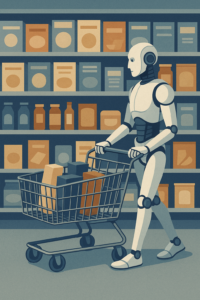
Agentic commerce means using an AI agent to work toward a shopping goal on a person’s behalf. Instead of just showing a list of search results, the assistant can understand a request, investigate options, explain tradeoffs and potentially take additional actions if it has the right tools and permission.
Here’s a simple example. You regularly buy a particular dog food, and your dog has a specific dietary requirement. Rather than remembering to reorder it every month, you might ask an assistant to watch your supply, compare available offers, and remind you when it’s time. A more capable future agent could place an order after checking the product, price and delivery window against rules you’ve approved.
There is an important distinction between recommending and purchasing. In late April 2025, ChatGPT started rolling out richer shopping results, including product images, prices, reviews and links to retailers. Those links take shoppers to merchants to buy. That’s a real example of AI-assisted discovery, not a claim that ChatGPT routinely completes all purchases itself today.
The bigger vision goes beyond finding an item. I think about it as a four-step journey: learning what matters to you, researching the market, taking an authorized action, and managing what happens afterward.
Step 1: Teaching the AI Agent About You
Before an assistant can be helpful, it needs to understand what you actually want. That doesn’t necessarily mean handing it unlimited access to your financial records or buying history. It can start with a few preferences you choose to provide.
- Product preferences: Brands you like, items you regularly buy, sizes, compatibility requirements and features you care about.
- Budget and value: Spending limits, whether you prioritize the lowest price or the best overall value, and whether faster delivery is worth extra money.
- Timing: How often you need a refill or when something must arrive, such as a gift before a birthday.
- Restrictions: Dietary needs for pet food, product allergies, merchant preferences or a rule that certain purchases always require approval.
The original idea included AI learning from purchase histories, conversations and calendars. That’s one possible direction if the customer explicitly connects those sources, but we shouldn’t assume every agent automatically has that information. Permission and privacy ought to be part of the design, not an afterthought.
My take: The advantage of a personal shopping agent isn’t that it remembers everything about you. It’s that it remembers the right things and lets you change your mind. Somebody who bought a certain brand last year may want to switch today. An intelligent assistant needs to listen, not simply repeat old buying habits.
Step 2: Watching the Market and Comparing Options
Once the assistant understands the request, it can help evaluate the available products. Think of all the research that normally happens before a purchase: checking prices, availability, specifications, shipping time and return policies.
For a repeat purchase, the goal may be simple. Does the usual coffee variety cost less from another reliable seller this week? Is the preferred product in stock? Will it arrive before you run out? For a new purchase, the problem is more interesting. An assistant could compare two or three phones based on camera quality, battery life, size, cost and the features you personally use.
There’s a trap here: the cheapest listed price is not always the best deal. Shipping charges, taxes, subscription requirements, delivery dates, condition and return restrictions can change the true cost. A comparison that doesn’t account for those details may send you in the wrong direction.
And just because an AI produces a convincing answer doesn’t mean its information is current. Product listings can be outdated and recommendations can be mistaken. I’d still want to see the seller, exact item and final total before approving a purchase, especially for anything expensive.
My take: The big improvement would be making comparison easier without removing the information people need to make a smart decision. Don’t hide the details just because the software promises a shortcut.
Step 3: Negotiating and Purchasing on Your Behalf
Here’s where the concept becomes a whole lot more ambitious. Imagine telling your assistant that you’re willing to spend up to $70 for a certain item. It checks several merchants, compares the total offers, and perhaps even asks whether one can match another seller’s price.
The original article pictured buyer agents communicating directly with seller agents to negotiate a deal. I can imagine that happening as retailers build more sophisticated systems. But in May 2025, automatic agent-to-agent price negotiations are a future possibility, not a universal feature available at every online store.
Purchasing also requires a different level of trust than researching. An assistant might need authorization to charge a payment method, select a shipping address and agree to a merchant’s terms. There ought to be clear controls, such as a spending limit, a defined category of approved items and explicit confirmation for unusual transactions.
- Low-risk reorders: A known item under a defined budget might eventually be eligible for automatic approval.
- New or expensive products: The customer should review the exact offer before spending.
- Price changes or substitutions: The agent should ask rather than assume an alternative is acceptable.
- Payment and privacy: Sensitive information needs strong safeguards, and the person buying must remain in control.
My take: Convenience is valuable, but no one wants an assistant that enthusiastically orders the wrong thing! I’d rather start with approval-based purchasing and expand automation only after the system proves reliable.
Step 4: Handling Delivery, Returns and Post-Purchase Support
The sale isn’t over when the payment is processed. The order needs to arrive, and sometimes things go wrong: a shipment is delayed, the wrong product is delivered or an item needs to be returned.
A useful assistant could eventually help follow shipment updates, alert you when delivery changes, gather the information needed to request a return and check whether a refund was issued. Those tasks often involve multiple emails, tracking pages and customer service conversations, so there’s a real opportunity to reduce friction.
But again, we should distinguish a useful concept from a finished feature. An agent can’t automatically resolve every dispute with every retailer unless it has access, authorization and a supported workflow. Human customer service may still be needed, particularly when the facts are complicated.
My take: I think post-purchase service is one of the most overlooked parts of the AI-shopping conversation. Finding a product is important, but handling a problem after delivery is where an assistant could earn lasting trust.
A Look at the Shopping Experience I Can Imagine
Here’s a scenario from the original article that captures the idea. Imagine you’re away on vacation and your household essentials need replenishing.
You’re on vacation. Your fridge runs low on essentials. Your AI agent checks the smart fridge, recognizes what’s missing, places an order with your preferred grocer, applies a coupon, selects the best delivery time based on your calendar, and sends you a simple notification: “Groceries will arrive Tuesday at 10am.”
That’s a compelling picture of where things could go. It combines inventory awareness, shopping preferences, pricing, scheduling and delivery. It’s also a good illustration of how many separate systems need to work together. The smart appliance, shopping agent, retailer, payment provider and delivery service would all have to exchange information accurately and securely.
Would I want a grocery order scheduled to arrive while nobody is home? Probably not! And what if the fridge thinks I’m out of milk when I’ve already bought some? The details matter, and customers need to be able to adjust the rules.
What Buyers Could Gain—and What They Should Watch
I can see four potential benefits: less time spent comparing routine purchases, fewer forgotten reorders, choices better matched to individual needs, and more help with the unglamorous work of returns and customer support.
But it’s worth considering the risks alongside the benefits. An assistant might mistake a product variant, trust an unreliable listing, overlook a shipping charge or recommend something based on incomplete information. It may also have incentives or commercial arrangements the customer doesn’t fully understand.
My opinion: A shopping assistant should clearly distinguish recommendations from advertising, show enough information to explain why a product was chosen, and make the final cost understandable. Trust grows when the buyer knows what the system is doing.
How to Get Ready Without Waiting for the Future
You don’t need to be a technology expert to experiment with some of the ideas right now. The simplest starting point is to use AI for research and comparison while keeping the purchasing decision in your hands.
- Start with one practical shopping question. Ask an AI assistant to compare several products based on a real need, not just identify the cheapest item.
- Check its work. Verify the specific model, seller, price, availability, delivery promise and return terms before ordering.
- Try a controlled reorder system. Existing subscriptions or reorder reminders can demonstrate the convenience of automation without granting unlimited authority.
- Define your preferences. Write down your size, compatibility requirements, preferred brands, budget ceilings and non-negotiables.
- Be selective with permissions. Don’t give a new tool broad access to purchasing or personal information unless you understand how it will be used.
Retailers should be watching too. If customers begin using intelligent assistants to compare offers, incomplete descriptions and unreliable inventory data will become harder to hide. And if automated purchasing eventually grows, the merchant still needs to handle payments, fulfillment, returns and customer service properly.
My Take: Give AI the Chores, Not the Final Say
I believe the opportunity behind agentic commerce is significant. We could spend less time sorting through products and more time getting the things we actually need. Repetitive purchases and routine follow-ups are natural candidates for automation.
At the same time, I wouldn’t want people to confuse the future vision with the capabilities already widely available in May 2025. AI-powered shopping recommendations are emerging. Fully autonomous agents that can negotiate, purchase and manage every return across all retailers are still a more ambitious step.
I’d like the assistant to do the homework, show me the options and eventually handle routine tasks under clear rules. But the customer should stay in charge of the budget and the important decisions. That’s how this becomes a better shopping experience rather than just a faster way to make expensive mistakes.
What would you be comfortable letting an AI assistant buy for you without asking? A reorder of dog food? Coffee pods? Or nothing until you’ve seen the final checkout screen? Those answers may tell us as much about the future of agentic commerce as the technology itself.
Sources and Further Reading
TechCrunch — ChatGPT introduces shopping results, April 28, 2025 · Reuters — ChatGPT shopping update, April 28, 2025
Disclosure: AI helped create this article