

TL;DR — The Takeaway
AI is changing how shoppers discover and compare products. A useful product card brings together the price, images, specifications, reviews, availability, and shipping details a buyer needs to make a decision. My message to eCommerce merchants: get your underlying product information right first. Better data benefits both human shoppers and the AI tools that may recommend your products.
I’ve watched eCommerce evolve from fairly simple online listings into a world of marketplaces, sophisticated search engines, personalized recommendations and increasingly complicated buying decisions. Now we’re approaching another change: what happens when the customer asks an AI assistant to help shop instead of typing a few keywords into a search box?
That question is what interests me about agentic commerce and something I’m calling attention to here: product cards. The term can sound technical, but the idea is straightforward. A product card is the compact presentation of the information somebody needs to understand and compare an item. It can be shown on a traditional marketplace, in a shopping search result or inside an AI-powered answer.
I don’t believe every merchant needs to throw out their existing eCommerce strategy to prepare for this. In fact, many of the things that matter most in AI shopping are the same fundamentals good merchants should already be practicing: accurate inventory, useful descriptions, quality images, competitive offers and a trustworthy buying experience.
From the Search Box to the AI Shopping Conversation
For years, online shopping has largely started with the buyer searching, browsing, filtering and comparing. A customer looking for a desk chair might visit several sites, sort by price, read reviews and try to determine which chair is actually comfortable. Some people enjoy the hunt. Others would gladly hand most of that work to somebody else!
With agentic commerce, a shopper might simply tell an assistant, “Find me a comfortable ergonomic chair for my home office for less than $300. It needs good lumbar support and should arrive next week.” The assistant could interpret those requirements, look across available product information, narrow the choices and explain why it selected them.
This isn’t entirely theoretical. In late April 2025, ChatGPT began rolling out more visual shopping results that can show product photographs, prices, reviews and links to merchants. These early experiences are mostly about discovery and comparison; that is different from an AI assistant being authorized to complete every purchase autonomously. But it shows the direction shopping interfaces are heading. See TechCrunch’s April 28, 2025 coverage.
What Exactly Is a Product Card?
Think of a product card as a digital salesperson’s quick reference sheet. It should communicate what the item is, who it’s for, what makes it different and what it will cost the customer. The best cards make important facts easy to compare instead of forcing shoppers to hunt through an entire page for answers.
Here’s a simple illustration of the concept from my original post:
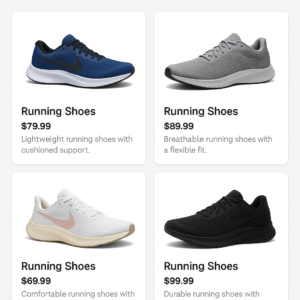
The card itself is the presentation, not necessarily a special file that every AI system reads in the same way. Different shopping platforms and AI tools may display products differently. The information behind those displays can come from a merchant’s product page, structured data, product feeds, marketplace records or other sources. That’s an important distinction because merchants control much of the information, but they won’t always control exactly how an AI interface displays it.
For instance, a merchant might provide five excellent photos and a long description. A shopping assistant might choose to surface just one photo, a short summary, the current price and a couple of distinguishing features. If the underlying catalog information is incomplete, the assistant has less reliable material to work with.
Seven Things a Useful Product Card Should Communicate
Whether the card appears on a retailer’s website, a marketplace or an AI shopping interface, I’d focus on these essentials:
- Product identity: A recognizable brand and product name, plus the model, size or variation when relevant. Make it obvious which item is actually for sale.
- Clear, honest photos: Show the item accurately, from useful angles, and include details that help shoppers understand scale, fit, finish or condition.
- Price and offer: Display the selling price and applicable promotion clearly. The final cost may also depend on shipping, taxes or other charges.
- Useful specifications: Dimensions, materials, compatibility, weight, features and product identifiers can help distinguish a true match from a lookalike.
- Ratings and reviews: Give shoppers context for customer feedback. A rating by itself is less useful if we don’t know how many people contributed or what they liked and disliked.
- Inventory and delivery: A recommendation isn’t very helpful if the item is out of stock or cannot arrive when the customer needs it.
- Return and warranty information: Especially for products with fit, performance or compatibility questions, clear policies can remove an important reason to hesitate.
I would add one more principle that isn’t always visible on the card: the information needs to be consistent wherever the item is listed. A product that shows one price on the website, another in a marketplace feed and an outdated availability status in search creates confusion. In an AI-assisted shopping experience, bad data may be repeated at the very moment a customer is ready to buy.
How an AI-Assisted Purchase Could Work
Here’s the shopping journey I envision as these systems improve. Not every AI tool can perform all five steps today, and some purchases will continue to require direct customer approval.
- The shopper explains the need. They describe the budget, purpose, preferences and delivery requirements in ordinary language.
- The assistant discovers possibilities. It searches available product information and considers which listings meet the stated requirements.
- The assistant compares and explains. It presents a smaller group of products, perhaps with cards that highlight price, specifications, reviews and important tradeoffs.
- The shopper chooses. The customer reviews the recommendation and decides whether a product deserves a closer look or a purchase.
- Checkout and fulfillment follow. The customer may click through to the merchant to complete the order. More autonomous purchasing could develop with permission and suitable payment safeguards.
What fascinates me is how this changes the work on both sides of the sale. The shopper might spend less time filtering through dozens of pages. The merchant might have fewer opportunities to win attention through clever navigation or a flashy homepage if the AI assistant has already narrowed the field before the shopper arrives.
Why Product Cards Matter to eCommerce Merchants
Visibility Starts With Relevant, Reliable Information
Traditionally, merchants have worked hard to show up when someone searches for a product. That work doesn’t disappear. But an AI assistant may try to understand the shopper’s intent more precisely than a short keyword phrase. If somebody needs an office chair that fits a small apartment, the seat dimensions, adjustability and shipping size could all become relevant.
My concern is that merchants sometimes treat product information as a chore. They enter the minimum necessary to get a listing live and move on. In a world of AI-assisted comparisons, thin product data may be a competitive disadvantage. Better information doesn’t guarantee a recommendation, but missing or inaccurate details certainly don’t help.
Trust Still Determines Whether People Buy
An AI assistant can make a recommendation, but the shopper still has to feel comfortable with the merchant and the item. Reliable pictures, clear terms, credible customer feedback and realistic delivery promises are all part of that confidence. This is especially important when the customer has never heard of the seller before.
I think merchants should resist the temptation to write product descriptions entirely for machines. The real customer is still a human being. Your listing needs to answer practical questions in language someone can understand, even if an AI system is involved in discovery.
Comparison Can Make Weaknesses More Obvious
There is a downside to making comparison easier: shoppers may see more clearly when one offer costs more, delivers more slowly or provides less information than another. A product card can help a strong offer stand out, but it can also expose a weak one. That’s not necessarily a bad thing. It encourages merchants to compete on real value.
Price isn’t the entire story. A dependable seller, a better warranty, clearer instructions or faster delivery might justify a higher price for the right customer. The goal should be to communicate what makes your offer worth choosing, not merely to stuff a card with keywords.
SEO, GEO and Structured Product Data: How They Fit Together
There’s already discussion about Generative Engine Optimization (GEO), or how businesses might become more visible in AI-generated answers. I think it’s worth paying attention to, but I wouldn’t declare traditional search engine optimization dead. Search engines, marketplaces and AI assistants may all use overlapping information, while choosing what to display in different ways.
One practical place to start is product structured data. Standards such as Schema.org Product and Offer can help make details like a product’s name, price, availability and reviews more explicit to systems that support those formats. Google has long offered merchant listing and product-result features based in part on structured data. That does not mean every AI shopping assistant reads Schema.org in exactly the same way, or that markup guarantees visibility.
A merchant’s website, product feed and marketplace listings should also agree on the basics. If the item is sold out, show that. If the price changes, update it. If a product comes in different sizes or colors, distinguish the variants correctly. You can review Google’s merchant listing structured data documentation for a practical starting point.
My opinion? Don’t chase a mysterious AI optimization trick while your product data is a mess. Start with the information you can control and make it accurate, useful and consistent. Those improvements are good eCommerce practices even if the industry’s next preferred acronym changes.
Five Practical Steps to Get Your Catalog Ready
If I were reviewing a merchant’s catalog for this shift, I wouldn’t start by buying a complicated new tool. I’d start by checking the actual listings and customer experience.
- Audit your best-selling and highest-potential products first. Identify listings with incomplete titles, missing specifications, outdated prices, weak photos or confusing variations.
- Make product information specific. Describe what the item does, who it suits and any important limitations. Include model numbers, compatibility and attributes customers routinely ask about.
- Review your product feeds and structured data. Make sure eligible merchant listings accurately reflect price, inventory, shipping and other supported details.
- Improve the buying experience. Test product pages on mobile, review shipping promises and return policies, and make it easy to find answers before purchase.
- Measure what actually improves results. Watch product discovery, engagement, conversion, returns and customer questions. A better-looking card is useful only when it helps the business and the buyer.
I’d also keep an eye on how AI shopping results are evolving. Try asking an assistant the kinds of questions your customers ask, then see what information it surfaces and what it leaves out. Use that as research into how your products are described—not as proof that one test reveals the rules of a secret ranking algorithm.
My Take: Better Product Data Is a Business Asset
I’ve seen eCommerce change plenty of times, and each wave of technology seems to arrive with a promise that everything will be different. Some parts really do change. But buyers still want the right item, a fair deal, dependable fulfillment and the confidence that they’ll get what they ordered. The tools for connecting buyers and sellers are what keep evolving.
That’s why I’m interested in product cards. They make the next generation of shopping easier to picture. Instead of asking customers to work through endless listings, an assistant may do the first round of research and offer a clear, manageable comparison. Merchants that communicate product information clearly should be better prepared for that experience.
I don’t think a beautifully formatted product card, by itself, is going to make anybody successful. The product has to be right. The information has to be right. The business behind the offer has to work. But as AI becomes part of the shopping process, getting those fundamentals right could matter more than ever.
It’s still early in this transition, and we have plenty to learn about how customers will use AI to shop. That’s exactly why I think eCommerce merchants should be watching it now. What would an intelligent shopping assistant discover about your products today? And would you be happy with the answer?
Further Reading
ChatGPT’s April 2025 shopping updates — TechCrunch · Google Search Central: Product merchant listings
Disclosure: AI helped create this article